BOOK TODAY

BOOK TODAY
AWARD WINNING TOUR IN DUBLIN

EASTER RISING COACH TOUR

EASTER RISING COACH TOUR

ATTENTION COACH and TOUR OPERATORS

ATTENTION COACH and TOUR OPERATORS
Our friendly and excellent guides are available as Step On Guides for any visiting tour or coach operators who may like a unique, entertaining and educational tour of Irish History and the events of Easter Week 1916.
Showing posts with label Auckland. Show all posts

Friday, November 10, 2023

DANIEL POLLEN - THE 9TH PRIME MINISTER OF NEW ZEALAND FROM RINGSEND, DUBLIN

PART ONE - DANIEL POLLEN A NE'ER DO WELL FROM

 RINGSEND BECOMES THE PRIME MINISTER OF 

NEW ZEALAND

PROLOGUE

In their book, ‘Touching on Deaths: a medical history of early Auckland (2000)’, on page. 83 and referring to "DANIEL POLLEN (1813–1896), Laurie Gluckman, Ann Gluckman and Mike Wagg wrote that,

‘Pollen was born in Dublin although it is unknown whether he obtained his MD in Ireland or the USA. Similarly, it is uncertain when he reached New Zealand, but he signed the address of loyalty to Hobson at the Bay of Islands and witnessed the signing of the Treaty of Waitangi. He entered practice in Parnell, in Auckland in 1841.’

According to the Irish Stew Podcast,

‘Daniel Pollen, the 9th Premier of New Zealand, was born in Ringsend in Dublin on the 2nd of June, 1812. Little is known of his early life until he arrived in New South Wales in Australia in the 1830s before moving on to Auckland, New Zealand in 1840.’

Political opponents questioned his medical credentials, fictional accounts of his father helping to build the US Capitol building and unfounded stories that Daniel Pollen spent time in the United States when in fact he was tending to the medical needs of his native Dublin.

HERE IS THE TRUE STORY OF DANIEL POLLEN,  THE IMMIGRANT WHO BECAME A MINISTER FOR IMMIGRATION AND THE NEW ZEALAND PRIME MINISTER FROM RINGSEND.

On St. Georges Day, Saturday April 23rd 1796, one hundred thousand Dubliners crammed onto the quays around the newly built Grand Canal Harbour to view the official opening by John Jeffreys Pratt, the Earl of Camden acting as the Lord Lieutenant in Ireland appointed by King George the third. This would be the culmination of the building of the Grand Canal that linked the River Shannon across Ireland to the River Liffey and out into the Irish Sea. The section from Portobello to this new harbour, the final link, had been completed and it was hoped that it would open both trade and passenger services for those who could afford it. The owners of the Grand Canal Company did not envisage the arrival of the railways less that fifty years later than would make the Irish canals almost obsolete. The Earl’s vessel sailed in from the River Liffey through one of the three locks, each one named after a Lord Lieutenant of Ireland, Westmoreland, Buckingham and of course Camden himself.


This is a painting of the opening by William Ashford hanging in the National Gallery of Ireland depicting the opening of the Locks.


And this is also a newspaper observation of the opening.

On the far side of the harbour the Lord Lieutenant’s ships enters through the lock into the harbour. But pay attention to the house with the smoke emanating from the chimney to the right of the ship. This was the home of the Grand Canal Company’s lock keeper and harbour master. The man appointed to the job was Hugh Pollen.

The house on the far side of the locks was the location of the original home for Hugh Pollen.


Hugh Pollen married Eliza O’Neill and they settled into a busy life in the harbour, looking after the locks and the commercial activities of the harbour, Hugh Pollen also operated small fishing boats and smacks that went out to the larger vessels in Dublin Bay to off load their cargos and bring them ashore. In May 1813, Hugh and Eliza had a son and Daniel Pollen was born. On June 3rd 1813, he was baptised in Haddington Road Catholic Church.


And this is the church book entry for the baptism. 


Daniel was still young as the country recovered having been engulfed by the 1798 rebellion and shortly afterwards by the Robert Emmet rebellion of 1803. The Act of Union abolished the Irish Parliament and the British authorities took a stronger control of how Ireland was governed.

Later in life he described his early years in Dublin,

‘In the closing years of the first quarter of this century, I was myself, as a boy, fighting with tiny weapons amongst those of my countrymen who were struggling for that freedom which they thought would be accomplished for them by what was then known as Catholic Emancipation. I can remember, too, with what determination I saved my pocket money how I stinted myself in the usual luxuries of sugar-stick and gingerbread — in order that I might have the delight, on the Sundays, of flinging the coppers that I had saved in the faces of my oppressors when I made my weekly contribution to what was known — in the vernacular of my country — as the ' rint '— ' the Catholic Rint.'

The Observer, 23rd May 1861[1]


Young Daniel went to Great Brunswick Street Select School for General Education. He then attended medical school ar Apothecary Hall 40 Mary Street, not far from the main thoroughfare of the city Sackville Street, later to be known as O’Connell Street. The Hall was part of the Royal College of Surgeons Dublin. He continued his studies in medicine and he qualified as an apothecary on September 17th 1833 having been examined by the Governor and Directors of the Apothecaries Hall, Dublin. Webster’s dictionary defines an apothecary as,

‘One who prepares and sells drugs or compounds for medicinal purposes.

In more modern times it referred to a pharmacist.

The Apothecary Hall records showing the qualification of Daniel Pollen September 17th 1833


He then returned to his native Ringsend and Irishtown where the Thom’s Directory lists the young Daniel Pollen as a Druggist and Apothecary, the old way of describing him as a chemist. He practised serving the local community from a house that stood here.


 His chemist shop was located along this section of Irishtown Road, where today you will find a betting office and a credit union office.

1835 Thom's Directory


He lived just up the road from his shop at Number 4 Tritonville Road but he found his work appearing the newspapers on May 7th 1836 ‘Saunders Newsletter’.
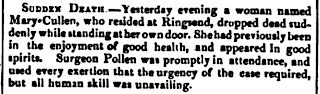
Freeman’s Journal May 1836

Daniel was one of eight children born to Hugh and Eliza Pollen. Daniel born in 1813, Thomas in 1814, James in 1817, John in 1819, Henry in 1824, Anne Catherine in 1831 and finally Hugh in 1834. Just three years after the birth of his namesake, their father Hugh died in 1837 and was buried in the grounds of St. Matthews Church in Irishtown. The role of lock master was taken by his son Thomas who was born a year after Daniel.

 The death of his father Hugh in 1837 may have been the catalyst to take the young medic abroad. It is likely that the lure of New Zealand was over whelming. But while he would leave the tumult of Ireland, he would arrive into the turmoil of New Zealand.


In early 1839 he first made his way to Sydney, Australia, which at that time would take between three and four months to complete. On November 30th he left New South Wales bound for the Bay of Islands on board The Martha.

Wednesday December 4th 1839, The Sydney Herald


According to the Australasian Chronicle[2], Pollen travelled from Australia to New Zealand with a group of French Catholic Missionaries including Fr. Joseph Chevron who would continue onto Tonga to spread the gospel.


He would not be the only Irishman to have an immediate impact on New Zealand life.  From the south of England port Plymouth, the Druid was being captained by John Spenser Churchill. He was the great granduncle of Sir Winston Churchill, the future UK Prime Minister. The Druid sailed on 25 August with Waterford born William Hobson and his family on board, arriving at Port Jackson, Sydney on 24 December. Hobson had already been to Australia and New Zealand some years earlier in command of HMS Rattlesnake as tensions mounted between the British settlers and on the North Island of New Zealand.


Hobson spent three weeks in Sydney, became acquainted with his immediate superior, George Gipps, the then governor of New South Wales, and selected his staff. Leaving his family behind in Port Jackson, Hobson sailed on the Herald on 19 January 1840, arriving at the Bay of Islands on 29 January. During the voyage he had heated arguments with the captain, Joseph Nias, who was obstructive of Hobson, apparently out of envy.


According to the New Zealand Government website,

‘The Treaty of Waitangi is New Zealand’s founding document. It takes its name from the place in the Bay of Islands where it was first signed, on 6 February 1840. This day is now a public holiday in New Zealand. The Treaty is an agreement, in Māori and English, that was made between the British Crown and about 540 Māori Rangatira (chiefs).

Growing numbers of British migrants arrived in New Zealand in the late 1830s, and there were plans for extensive settlement. Around this time there were large-scale land transactions with Māori, unruly behaviour by some settlers and signs that the French were interested in annexing New Zealand. The British government was initially unwilling to act, but it eventually realised that annexing the country could protect Māori, regulate British subjects and secure commercial interests.’


Lieutenant-Governor William Hobson had the task of securing British sovereignty over New Zealand. He relied on the advice and support of, among others, James Busby, the British Resident in New Zealand. The Treaty was prepared in just a few days. Missionary Henry Williams and his son Edward translated the English draft into Māori overnight on 4 February. About 500 Māori debated the document for a day and a night before it was signed on 6 February. Pollen was one of the witnesses to the signing of the Treaty by the Māori leaders,


By May 1840, just months after his arrival this letter from Pollen appeared in the newspaper self-reporting that he witnessed the signing of the treaty.

Published May 5th 1840.

With the treaty in place and business in the new British colony beginning to expand, Pollen was one of the merchants behind the creation of New Zealand’s first bank.


[3]

The idea of a New Zealand-based bank was first raised in 1840s, and at a meeting in the Bay of the Islands on 2 May 1840 the first offering of shares in New Zealand was launched. The bank was established on September 1st 1840 at Kororareka in the Bay of Islands with about  £7,000 of capital. Half the shares were held in Sydney and the other half by residents on the Bay of Islands. The manager was Alex Kennedy and the first directors were Gilbert Mair, Edward Williams, Henry Thomspon, James Reddy Clendon, Daniel Pollen, John Scott, William Mayew and Philo Perry.


After the move of the seat of government to Auckland a branch was set up in Auckland in 1842. An attempt was also made to move the principal office to Auckland but this was unhappily ineffectual. The failure of the move decided the fate of the enterprise, and although it struggled on it finally succumbed in 1845. The bank was wound up and all liabilities to the public were paid, although the final capital was not returned to shareholders until February 2nd  1850.


 Pollen moved from Kororareka south to Auckland. Pollen immediately became part of the life of  Auckland where in 1842 his residence is listed on a list of potential jurors as Princes Street. Pollen was then appointed Coroner for Parnell in 1844.


END OF PART ONE

In Part Two, Daniel will find a wife, take a more active role in the politics of New Zealand and for the boy from Ringsend, and reach the pinnacle of Kiwi politics becoming Prime Minister.


SOURCES

THE NEW ZEALAND GOVERNMENT WEBSITE

IRISH NEWSPAPER ARCHIVES

THE BRITISH NEWSPAPER ARCHIVES

THE PEMBROKE ESTATE ARCHIVES

THE NATIONAL LIBRARY OF IRELAND

THE NEW ZEALAND NEWSPAPER ARCHIVES

THE AUSTRALIAN NEWSPAPER ARCHIVES

ANCESTRY.COM

GOOGLE EARTH

THE RINGSEND & DISTRICTS HISTORICAL SOCIETY

THE IRISH INLAND WATERWAYS

THE NATIONAL GALLERY OF IRELAND

CORMAC LOUTH


[1] https://timespanner.blogspot.com/2008/12/daniel-pollen-warts-and-all.html

[2] December

[3] Saturday October 17th 1840

Monday, January 15, 2018

The Irish Statesmen Abroad - The Series

The 1916 Easter Rising generated a generation of Irish leaders and statesmen but as a small island we have punched well above our weight providing statesmen for nations across the world. This series published everyday over the next two weeks looks at their stories.

Episode Five - The Irish Premier's of Tasmania

It has been an Australian state since 1901, the island of Tasmania off the south east coast of Australian has a long and proud association with Ireland. The island is roughly the same size as Ireland but with a population of only just over half a million it has been part of Australia since 1856. Through the 1800s more than thirty percent of all migrants to Tasmania were from Ireland. Two Irishmen have risen to the top of Tasmanian Government attaining the position of Premier of Tasmania.

Sir James Wilson Agnew was born on October 2nd 1815 in Ballyclare, County Antrim.  After an education in Ireland, London and Paris be qualified as a medical practicioner and soon after qualification emigrated to Sydney, Australia. By 1846 he had married Louisa Mary Fraser but she passed away in 1868. He married a second time ten years later to Blanche Legge who had been born in County Tipperary. He moved to Melbourne but was unsettled but he was then offered a position in what was then known as Van Diemen’s Land now Tasmania. He would eventually become the colonial surgeon in the General Hospital in the capital Hobart. In 1877 he had left medicine and took up full time politics being elected to the Tasmanian Legislative Assembly. He was appointed to the cabinet as a minister without port folio but in 1881 he returned to Europe.

By 1884 he had returned to Tasmania and was once again elected to the Legislative Assembly. On March 8th 1886 he succeeded Adye Douglas as Tasmanian Premier only to retire from the post and politics just over a year later on March 27th 1887. In November 1901 by now a widower for a second time he died in the state capital of Hobart. In his obituary in the Daily Telegraph in Tasmania Agnew left a lasting legacy in Tasmania when the newspaper reported
‘In 1888 at a cost entirely by himself, he arranged for a shipment of 400,000 salmon ova to be brought to Tasmania under the care of Sir Thomas Brady, then inspector of fisheries for Ireland. The result of the experiment proved entirely satisfactory, and anglers in the future, as they do now, will bless the name of the genial doctor, who was mainly instrumental in introducing these fine fish to Tasmanian waters. Dr. Agnew was knighted by the late Queen Victoria, in 1894’

The name Gray has been synonimous with Irish politics since the days of Daniel O’Connell with Sir John Gray a well known vocal supporter of O’Connell and founder of the Freeman’s Journal newspaper an elected Irish MP for Kilkenny. Sir John’s son was Edmund Dwyer Gray who took over the running of the nationalist newspaper upon the death of his father in 1875. Edmund also served as Lord Mayor of Dublin and was an elected MP to the British House of Commons. His only son Edmund junior would also succeed his father at the newspaper but his political life would take him to the other side of the world.

Edmund John Dwyer Gray was born in Dublin in April 1870. After an education that included Clongowes Wood College he joined the staff of his family’s newspaper but a bout of rheumatism seen him travel to Australia hoping that the better climate would soothe his aches.  He made several trips down under but on one occasion back in married found time to marry Clara. The upheaval of the scandal surrounding his newspapers support of Charles Stewart Parnell’s affair with Kitty O’Shea hastened his permanent relation to Australia. After some travelling to Fiji and New Zealand, the Gray’s found themselves in Hobart, the capital of Tasmania. He settled as a farmer but had become involved again with journalism taking over as editor of the Daily Post a newspaper for the Australian Labor Party.

In 1915 he unsuccessfully ran in the state elections but in 1928 with a stroke of the pen when he hyphenated his name to Dwyer-Gray he found himself at the top of the ballot paper and won a seat representing the area of Denison. He rose to the rank of Deputy Premier under Albert Ogilvie and when Ogilvie died of a heart attack on June 10th 1939, Dublin born Edmund Dwyer-Gray became Premier of Tasmania. He only held the position until December 18th 1939 but was Premier at the outbreak of World War Two. He died in Hobart in December 1945. 

In Dublin’s O’Connell Street opposite a statue of grandfather John Gray stands the statue of William Smith O’Brien who was one of the leader of the failed 1848 rebellion and who in the aftermath found himself transported to Van Diemen’s Land for his crime of rebellion. Smith O’Brien was the brother of Lucius O’Brien, the Lord of Inchiquin who ancestoral home was Dromoland Castle. Beatrice, the grand daughter of Lucius married Gugliemo Marconi the inventor of wireless telegraphy and radio.


Perhaps one of the most successful of the Irish convicts in Tasmania was Richard Dry, convicted in Dublin in 1787, and sentenced to life for political activity and sedition. One of his sons Richard became the 7th Premier of Tasmania in 1866 and would eventually became the first Australian to be knighted. Richard Dry Senior was given a grant of 500 acres in 1818, as a reward for working as a commissariat clerk. Dry and his tenants were working 300 acres of land, and had almost 4,000 cattle and 7,000 sheep. By 1827 he had 12,000 acres of land. 

Sunday, January 14, 2018

Irish Statesmen Abroad - The Series

  The 1916 Easter Rising generated a generation of Irish leaders and statesmen but as a small island we have punched well above our weight providing statesmen for nations across the world.                    This series published everyday over the next two weeks looks at their stories.

Episode Four - The Premier's of the Australian State of Victoria

Born in Ballinahow, County Tipperary John O’Shanassy would become the Australian state of Victoria’s second Premier. He initially held the post for a month March – April 1857 but his Government fell and he was replaced as Premier by the man he himself had replaced William Haines. On March 10th 1858 he once again became Premier of Victoria and a powerful Irish Catholic alliance dominated a mainly protestant Victoria with O’Shanassy’s Deputy Premier Charles Gavin Duffy. This led to sectarian tensions in the state but relations between the two men deteriorated as Irish politics came between the two politicians, the two men on opposite sides of the 1848 Irish Rebellion.


Their Government fell in October 1859 but O’Shanassy was back in the Premier’s seat one final time from14th November 1861 to 27 June 1863. In 1866 he returned briefly to Ireland where he was presented with a banquet ‘fit for a king’ in his native Tipperary. He was asked by the Cork Examiner if he had seen any change in Ireland since he had departed the newspaper reported,
'When a man returned to Ireland after a long absence, a natural question was, do you see any great change in the country? He answered at once 'I do.' He saw the agricultural position of the country was better than when he left it. He saw an improved price for labour, making a very considerable difference in the condition of the labouring population. He saw railways opened, and an excellent system of roads, which, were a great improvement upon what existed when he was there before. And he saw, what was peculiarly pleasing that Ireland had been complimented by politicians on every side because in the matter of ordinary crime her calendar was almost a blank. He had also noticed a marked development in ecclesiastical architecture in this country — the united zeal of the people and their pastors building magnificent churches, that were strong proofs of the sincerity of religion conviction of those who worshipped in them. In social matters, too, he saw marked progress, for now men of every shade of opinion, religious and political, could come together to promote a common object. ‘

He retired from the Victoria State Parliament in February 1883, shortly before his death in May of that year in Boroondara, Victoria, Australia.

Having served as Deputy Premier under O’Shanassy, Gavin Duffy would go on to be the 8th Premier of Victoria with a history of rebellion left behind in Ireland before his departure to Australia.  Duffy was born on Dublin Street, Monaghan Town, and the son of a shopkeeper. Both his parents died while he was still a child and his uncle, Fr James Duffy, who was the parish priest of Castleblaney became his guardian for a number of years with an education achieved in Belfast. Gavan Duffy was one of the founders of The Nation and became its first editor; the two others were Thomas Davis and John Dillon, who would later become Young Irelanders. All three were members of Daniel O’Connell’s Repeal campaign. The paper, under Gavan Duffy, transformed from a literary voice into a "rebellious organisation"

As a result of The Nation's support for Repeal, Gavan Duffy, as owner, was arrested and convicted of seditious conspiracy as the result of a Monster political Meeting that was planned for Clontarf in North Dublin city. This was also a period of rebellion with the Young Irelanders 1848 rising that centered on County Tipperary, more familiarly known today as the ‘Cabbage Patch rebellion’.

In 1852 he was elected an MP to the British House of Commons for the constituency of New Ross, retaining his seat until his resignation in November 1855. Tiring of the malaise that was Irish politics, Gavin Duffy decided to cross the world to Australia and arrived in Victoria State. He was feted when he arrived and a public campaign changed the rules for those who could be elected to the state legislature. In 1856 Gavin Duffy entered Victorian politics being elected for the constituency of Villiers and Heytesbury
 .
In 1871 Duffy led the opposition in parliament to Premier James McCullough’s plan to introduce a property tax on the grounds that it unfairly penalised small farmers. When McCulloch's government was defeated on this issue, Duffy became Premier and Chief Secretary (June 1871 to June 1872). Victoria's finances were in a poor state and he was forced to introduce a tariff act to provide government revenue, despite his adherence to the then British principles of free trade.

As an Irish Catholic Premier he was very deeply unpopular with the Protestant majority in the state and Duffy was accused of favouring Catholics in government appointment. In June 1872 his government was defeated in the Assembly on a confidence motion allegedly motivated by sectarianism. He was succeeded as premier by the conservative James Francis and later resigned the leadership of the liberal party.

In 1874 he returned briefly to Ireland and was offered a seat by the Irish Parliamentary Party in the House of Commons but he declined returning to Victoria. In 1880 he left Australia for good and moved to the south of France. He died in 1903 having outlived three wives. His body was returned to Ireland for a large funeral through the streets of Dublin. 

Friday, August 18, 2017

Somethings Never Change

"A lodge of Orangemen, were attacked, simply because their appearance gave offence to a number of men who hold different religious opinions. We can only characterise such conduct as disgraceful in the extreme. We are quite prepared to admit that an Orange Lodge may be an eyesore to some few bigoted Catholics, on just the same grounds as bigoted Protestants may feel offended at the sight of the Hibernian Society in regalia but the fact that a man feels hurt at another man parading his opinions does not give him the right to attack him, tear off his regalia, and beat him. If this conduct were allowed, we should soon have graceless zealots of either persuasion wanting to tear down the chapels and churches of those who differed from them.
If the "wearers of the green" wish to show their opposition to Orangemen, it would be an easy matter' for them to get up a counter procession, with their , own banners and distinctive badges. Surely that would be a bettor kind of opposition than dealing in bludgeons, shillalahs, and similar weapons. This sort of thing must be stamped out at once. Public safety demands it. The right of every man to enjoy his own opinions, and of every body of men of one mind to walk through the streets without fear of molestation, must be upheld. We therefore trust those who have outraged the public peace will be punished severely not only because their offence is great, but also because the hatreds and dissensions must be prevented from taking root amongst the youth of this country."


A December 1879 newspaper article describing sectarian riots in Christchurch, New Zealand

Monday, July 3, 2017

Irish born Statesmen Abroad - NEW ZEALAND

Much has often been written about the ancestral connections of US Presidents with Ireland but Irish citizens have travelled the world becoming much loved and treasured statesmen in other nations. Ireland has produced three Irish born Prime Ministers of New Zealand. These are their stories.

DANIEL POLLEN

On July 8th 1875 Daniel Pollen became the Prime Minister of New Zealand. Daniel was the son of Hugh Pollen, a dock master at the mouth of the newly opened Grand Canal as it entered the River Liffey and Elizabeth O’Neill. Daniel was born on June 2nd 1813 when the family lived in what later became known as Pollen Cottage in Ringsend. Hugh Pollen received both the house and an annual salary of £100 per annum for his role as dock master.

Little is known about the early part of his life, but it is supposed that he grew up in Ringsend before emigrating to New Zealand in 1840, shortly after his father died in 1837 and the role of dock master and use of the house was taken over by Thomas Pollen, brother of the late Hugh. He arrived at the Bay of Islands settling in a town called Parnell near Auckland which probably made him feel right at home. He practiced as the local doctor but Daniel also became actively involved in politics with the formation of the Auckland Province in 1852 and was well regarded as a great debater and famous for his wit.

Two years after he was appointed the local coroner in 1846 he had married Jane Henderson a daughter of a Royal Naval officer and they went onto to have four sons and four daughters. Pollen entered politics first serving on the local provincial council representing Auckland East and then became a member of the New Zealand Parliament on May 12th 1873.  He rose through the political ranks and served in the Government of Julius Vogel as Colonial Secretary but when that Prime Minister left New Zealand to travel to Great Britain, Daniel Pollen from Ringsend in Dublin was appointed July 6th 1875 as Prime Minister of New Zealand. He held the position until the return of Vogel on February 15th 1876 when he returned to the position of Colonial Secretary and continued in that position under the following Prime Minister Harry Atkinson before he retired from politics.

Pollen died at his residence ‘The Whau’ in Avondale in 1896.

JOHN BALANCE

The 14th Prime Minister John Balance was born in Ballypitmave near Lisburn in County Antrim in March 1839. Born into a farming community to father Samuel, John Balance was the eldest of eleven children. As an eighteen year old he headed for Belfast City before crossing the Irish Sea to live in Birmingham. While there in 1863 he married a butcher’s daughter Fanny Taylor. His new bride became ill and the decision was taken in 1866 to immigrate to New Zealand where Fanny’s brother lived.

Once in New Zealand after a brief period as salesman he studied to become a journalist and from journalism he found his way into local politics. The move for the Balance couple down under proved futile as two years after their arrival down under Balance’s wife passed away. Two years later he married Ellen Anderson and the couple adopted a daughter Kathleen.

He was first elected to parliament in 1879 only to loose his seat in the subsequent election by just four votes when a horse drawn coach shed a wheel and seven of his supporters inside failed to register their vote. He won the seat back in 1884 and joined the Julius Vogel cabinet as Minister for Native Affairs. Out of Government, Balance accepted the role as leader of the then opposition Liberal Party. When the Government of Prime Minister Atkinson resigned, Balance became the Prime Minister in January 1891.

As Prime Minister he attempted to turn his Liberal party into a nationwide party rather than just regionally based. He was not known as a charismatic leader or a good public speaker, he was described as honest, courteous and displayed great patience and integrity. His wife became a leading figure in the fledgling feminist movement in New Zealand. His success as a Prime Minister was short lived as he developed cancer and passed away on April 27th 1893 receiving a state funeral in his home town of Wanganui. His wife Ellen outlived her husband by forty two years. 

WILLIAM MASSEY

The 19th Prime Minister of New Zealand was William Massey who was born in Limavady, Derry in March 1856. He was a member of the Reform Party, a political force he helped to found, when he became PM in 1912. Born into a farming Presbyterian family, the family moved to New Zealand in October 1862 without young William who remained in Ireland to complete his education. He followed the family over to the far side of the world in December 1870.

He became involved in local politics through the local school board before being elected in an 1894 by election for the constituency of Waitemata before contesting the 1896 General Election for the neighbouring constituency of Franklin which he represented until his death in 1925.

After founding his reform Party in 1909, they became the largest party after the 1911 General Election but the incumbent Liberal Party remained in power with the support of Independents. The Liberals lost a vote of confidence in Parliament and Massey was invited to form a new administration and officially became Prime Minister on July 12th 1912. His first years in power were a period of great industrial unrest and his use of force to break strikes did not endear him to either his electorate or party colleagues but like many other politicians across the world the intervention of the First World War diverted attention from domestic matters. In the 1914 General Election no party won enough seats to be effective as a Government and Massey invited the leader of Liberal Party Joseph Ward to be party of a national unity Government in time of war.

Massey signed the Versailles Peace treaty on behalf of New Zealand at the end of the war. With war at an end the unity coalition fractured and in the 1919 General Election despite the rise of the new Labour Party, Massey and his Reform Party won a majority. He governed a troubled New Zealand both socially and economically until the 1922 General Election where he failed to win his majority winning just 37 of the 80 available seats but clung to power with the support of Independents.

His health deteriorated in 1924 and he passed away in 1925.