BOOK TODAY

BOOK TODAY
AWARD WINNING TOUR IN DUBLIN

EASTER RISING COACH TOUR

EASTER RISING COACH TOUR

ATTENTION COACH and TOUR OPERATORS

ATTENTION COACH and TOUR OPERATORS
Our friendly and excellent guides are available as Step On Guides for any visiting tour or coach operators who may like a unique, entertaining and educational tour of Irish History and the events of Easter Week 1916.
Showing posts with label Irish history. Show all posts

Thursday, November 18, 2021

The Pubs of Ringsend Walking Tour - Episode One 'NORTH'S'


Coming in 2022, following the successful ‘The History of Sandymount’s Pub Walking Tour’ and ‘The Pubs of Rathmines Tour’, we will be bringing you ‘The Pubs of Ringsend Heritage Walking Tour’. To whet your appetite for some of the stories and tales you will hear, we will bring you over the coming weeks some of the histories of the pubs no longer open. Today we will be starting with North’s public house, in coming weeks we’ll bring you the histories of The Sign of the Highlanders, The Old England Tavern and the Hobbler’s End.


Now just a memory, but for many of an older generation in Ringsend and Irishtown, Peter North’s pub on Bridge Street in Ringsend brings back happy memories. Alas long gone but if you walk through the lounge door of John Clarke’s public house today you will have walked the route of many of North’s customers.


Peter North was a popular publican who received extensive coverage in Irish newspapers in October 1967. Peter was celebrating his hundred birthday and was described in the Irish Press as ‘probably the oldest publican in the country’. While still living above the pub, he had retired from serving pints to the locals just three years earlier as his health began to fail.


He had been born on Upper Baggot Street and served his first pint, aged sixteen, in the pub that had been opened by his father Morgan North in Ringsend. A lively sportsman, Peter, along with his brothers Francis and Bartle, played for the Isles of the Sea GAA hurling club and they won the Dublin County Championship in 1890. Peter later recalled,

‘it was some sight with 42[1] players on the field. There used to be some awful scrimmages.’

Source: The Irish Newspaper Archives

His brother Bartle was the first superintendent of the electricity generating station at the Pigeon House when it opened in 1904[2]. His son Bartle junior became a popular bookie in Ringsend with a shop on Fitzwilliam Street. Morgan North’s public house was located on the corner of Fitzwilliam Street and Thomas Street as it was known then, now known as Irishtown Road. The newspapers reported that in 1910 Peter North of 16 Fitzwilliam Street was fined by the courts for allowing children on his premises despite the fact that their mother was with them.

Morgan North pictured at the door of his pub on Fitzwilliam Street pictured in 1910
Source : Brian Siggins through his son Gerard

Today that former North public house is home to the National Council of the Blind shop. Morgan’s only daughter Mary Catherine married Valentine Nelson, the son of another Ringsend publican Joseph Nelson. The Nelson’s also ran a butcher shop on Bridge Street. In the early twentieth century, following a Pembroke Estate decision to renovate many of the properties on the part of Fitzwilliam Street that connected with Cambridge Avenue, by 1916 the North’s had moved their public house to a building next door to the Nelson’s on Bridge Street. Peter often fell foul of the licensing laws and was raided and fined on a number of occasion for serving outside permitted hours including on Good Friday 1940 after which he was fined £2 and had his license endorsed. The following June he was raided again for serving afterhours with thirteen customers on his premises. He was fined twenty shillings and was lucky not to lose his license.

Source: Google Maps

Source : National Archives of Ireland

The pub on the Fitzwilliam Street had seen previous owners Michael Holden in the 1830’s and Edward Smith in the 1850’s before the North’s arrival. Following Morgan North’s premature death at the age of just forty five, his pub’s license was operated by Anne Lowe who seemingly employed the young Peter North as a barman until he became of age to run the pub himself.

Source: Brian Siggins

Having celebrated his centenary in October 1967, just three months later in December the popular local Ringsend publican passed away peacefully and enjoyed one of the biggest funerals seen in the south Dublin suburb. When both Nelson’s[3] pub and North’s pub were sold they were joined into one pub with a bar and lounge owned by the popular Dublin publican family, the Dwyer’s.  Today the pub is occupied by John Clarke and family who had traded for many decades successful just up the road in Irishtown.

Peter North's pub receiving a delivery of beer.


[1] 21 per side was replaced by the current 15 a side

[2] Died September 1936

[3] Sold 1968


Sunday, November 8, 2020


Purchase your signed copy of this important historical account of the role of Pubs, Publicans and their staff in the fight for Irish Independence. 

Pay via secure paypal by contacting


thirstforfreedom@mail.com


with your contact details. 

Wednesday, September 25, 2019

Diarmuid Fawsitt, An Unusual Diplomat


Diarmuid Fawsitt, An Unusual Diplomat

In September 1919[1], with the War of Independence raging in the Irish countryside, across the Atlantic the fledgling State had appointed Jerimiah (Diarmuid) L. Fawsitt as Consul General in New York and led the first official Irish Trade Commission. The United States was vital as pressure on the Wilson administration would be vital in achieving legitimacy and the diaspora on the far side of the Atlantic would be both a source of fundraising for the campaign against the British and an important trading partner when Independence was won.  The Consulate opened offices located at Suite 404 in 280 Broadway, Manhattan and Fawsitt was the first appointee of the new Dail Eireann.  

He was born in Bandon, Co. Cork and made his name as the Secretary of the Cork Industrial Development Association. He forcefully encouraged overseas business to both invest in Ireland and to trade with Ireland. One of his great successes was encouraging Henry Ford to build his first car factory outside the United States in Cork. When DeValera arrived in the U.S. in June 1919, he introduced Ford to DeValera. As a fellow Corkonian he also enjoyed a very close relationship with Michael Collins and was pro-treaty when the peace arrived.

The son of a Cork builder, he joined the IRB in February 1904. In 1911, he married Tipperary born Kathleen Kenny and the couple see eleven children born up to the youngest Ethna in 1931. Fawsitt became President of the Executive of the Volunteers in Cork[2] which he helped found in 1913. He was involved with Sir Roger Casement and helped to fund the arms shipment from Germany in advance of the Easter Rising. In 1915 he was ordered by the British authorities to leave Cork and he travelled across the Atlantic and went on a lecture tour laying the ground work for his appointment as the first Irish Consul in New York in 1919.

Even before his departure for the United States, in January 1919 he received a polite rebuff from the White House after inviting President Woodrow Wilson to visit Cork. He battled hard to improve direct trade between Ireland and the United States and throughout 1919 battled to get a direct shipping route from the East Coast of America to Cork striking a deal with the Moore and McCormack Line. Much of the then trade traveled by ship across the Atlantic to Liverpool and Southampton before being then sent onwards to Ireland. While serving in New York he had several run ins with fellow Irish-American James O’Mara, who complained to Dublin about the extravagance of the Irish consulate in NY and at one stage refused to pay a $32,000 maintenance bill eventually the dispute forced DeValera himself to step in and resolve the issue. In an era where rumour and gossip often had an impact on views, Fawsitt was rumoured at one time to be involved on the orders of DeValera to kill James Larkin while he was in the US. Larkin was seen as an agitator and troublemaker and was now overly welcomed back to Ireland in the early days of the new State.

In August 1920 left the job and returned to Ireland He was officially replaced in October 1921 by Belfast man Joseph Connolly. In 1920 he traveled across the US to San Francisco to take part in the welcoming committee for the controversial Australian Archbishop Daniel Mannix and he wrote a moving obituary in the US newspaper for his former schoolmate the late Thomas McCurtain, the Cork Lord Mayor who had died on hunger strike. Fawsitt was an economic advisor at the Anglo-Irish Treaty negotiations in 1922 and subsequently became an assistant secretary of the Department of Industry and Commerce (1922-23), and in this position played a role in developing the scheme for compensation and reconstruction following the burning of Cork in December 1920

Fawsitt went on to become a leading Judge and he died April 1967 and is buried in Sutton, Dublin along with his wife who pre-deceased him. Their grandson Duncan Stewart is a well-known television personality, while their daughters Sheila, Kathleen and Marie had roles in the 1937 film Some Say Chance.


[1] http://www.bureauofmilitaryhistory.ie/reels/bmh/BMH.WS1728.pdf#page=10
[2] http://www.bureauofmilitaryhistory.ie/reels/bmh/BMH.WS0939.pdf#page=119

Saturday, June 29, 2019

The Battle of Bass Ale


The Battle of Bass
Many moons ago when I was a bar manager, the pub I worked in had been renovated and a well-known Dublin politician was to perform the opening ceremony but the only stipulation was that I had to have a pint of Bass for him, a product that at that time was not a great seller and once the opening was performed within a week the tap had been removed. There had been a sea change in Irish politics after the battles of the civil war and Eamon DeValera had taken power in March 1932 but despite his movement away from the IRA, including naming his new party Fianna Fail, the IRA remained in the shadows. The organisation manifested itself under different guises including in November 1932 as the ‘Boycott British Goods League’. The Leagues campaign was aimed at one particular company, the British ale brewery Bass.

Bass had already been subject of an earlier boycott in Ireland from 1918 to 1924 as it was a huge seller in Ireland, probably second only to Guinness with a bottle costing the customer 8d and a draught Bass between 10d and a schilling. Bass was targeted because one of its directors was Colonel John Gretton, who was in 1932 a Conservative Party MP and an Olympic gold medallist in sailing, was seen to side with the Unionists in Ulster and during the conscription crisis he was quoted as saying ‘send every young Irishman to Flanders, then the Irish race will be exterminated’.  The Boycotters also advised that there were plenty of alternative Irish made Ales for the consumers.

In Dublin the company, Bass, Radcliffe, Gretton and Company imported their casks on ships to the Liffey Quays and then moved them by horse and dray to a warehouse they maintained on Moore Lane. From there the drays would deliver to pubs in the inner city, by truck to Leinster and by train to the rest of Ireland. In November 1932 came the first reports of draymen being attacked and their casks of Bass emptied into the gutter began to emerge.

In December especially in Dublin, publicans were visited by armed men and told that they had seven days to get rid of their Bass stock or face some serious consequences, some threatened with being burned out of business. The problem for publicans was that Bass ale needed to mature in stock before being served and with the run up to Christmas publicans carried a lot of Bass stock. The Minister for Defence Fianna Fail man and War of Independence veteran Frank Aiken said when questioned in the Dail by TD’s allied to the Licensed Vintners Association said that there seemed to be ‘concerted activity amongst members of the Irish Republican Army and kindred terrorist organisations’.  The ‘Army Comrades Association’ known as The White Army made up of veteran IRA men who had sided with the Treaty forces at a meeting in the Mansion House said that they were willing and able to assist the publicans in the protection of their businesses from what they described as ‘a bunch of hooligans’.

On December 14th there was an armed raid on the Bass warehouse at Lavitt’s Quay in Cork with all the stock destroyed. Casks were emptied and bottles smashed although it was reported over the festive period that bottles of stolen Bass was seized in a pro-IRA shebeen near Macroom. The next day on Dublin’s north quays a dray moving stock from the port warehouse to Moore Lane was attacked and twenty casks emptied onto the streets. On the 20th, sixteen men from the ‘White Army’ escorted a convoy of drays from the Quays to Moore Lane which itself was now protected by armed guards.

The campaign in early 1933 consisted mainly of attacking Bass signage and advertising inside and outside pubs and in some cases especially in rural areas, hammers were used to smash ads in pubs where only a barmaid was on duty. The boycott and intimidation campaign intensified once again towards the end of the year. In August there were attacks on pubs in Dublin, Killarney, Midleton and Waterford, with masked men entering the pub and ordering the publican to cease buying or selling Bass and destroying the Bass stock on the premises. In September there were more attacks in Dublin stretching from Sandymount to Pimplico Merrion Row to Patrick Street and Henry Street to Stoneybatter. Across the country there were attacks in Ballinrobe, Dun Laoghaire, Clonmel, Navan and Tramore. Armed Gardai were protecting trains as they travelled across the country. Thirty-five pubs were visited in Monaghan on one night by a large group of armed and masked men.

Some of those arrested were jailed for their offences and then in Mountjoy Jail they went on a failed Hunger Strike in an attempt to be released. The attacks trailed off, in October there was just one reported attack in Clare and in November only Tramore suffered the intimidation from the Boycott movement. Pressure from the DeValera Government had reduced the numbers involved and the fact that courts were not showing any leniency, the campaign against Bass ended.  

Friday, January 19, 2018

Irish Statesmen Abroad - The Series

The 1916 Easter Rising generated a generation of Irish leaders and statesmen but as a small island we have punched well above our weight providing statesmen for nations across the world.                    This series published everyday over the next two weeks looks at their stories.

Episode Nine - Natal


Sir Albert Hime was born at Ballydonerea House near Kilcoole County Wicklow in August 1842 and received a third level education at Trinity College as an engineer. Soon after marrying Josephine Searle he found himself in Bermuda working on a major engineering project constructing a causeway. He travelled again in 1875 across the Atlantic but this time he found himself in South Africa and the Colony of Natal, a British colony created after the born war and the short lived Natalia Republic. In 1878 Hime designed and built the Natal Mounted Police Headquarters.


On June 9th 1899 Hime was appointed the Premier of Natal replacing Sir Henry Binnes. In his role he attended the coronation of Edward VII in 1902 and visited Dublin to receive a hononary degree from UCD before returning to Natal. Hime remained Premier until August 17th 1903. The post of Prime Minister of the Colony of Natal also became extinct on 31 May 1910, when it joined the Union of South Africa. He remained in Natal until his death in 1919. 

Monday, January 15, 2018

The Irish Statesmen Abroad - The Series

The 1916 Easter Rising generated a generation of Irish leaders and statesmen but as a small island we have punched well above our weight providing statesmen for nations across the world. This series published everyday over the next two weeks looks at their stories.

Episode Five - The Irish Premier's of Tasmania

It has been an Australian state since 1901, the island of Tasmania off the south east coast of Australian has a long and proud association with Ireland. The island is roughly the same size as Ireland but with a population of only just over half a million it has been part of Australia since 1856. Through the 1800s more than thirty percent of all migrants to Tasmania were from Ireland. Two Irishmen have risen to the top of Tasmanian Government attaining the position of Premier of Tasmania.

Sir James Wilson Agnew was born on October 2nd 1815 in Ballyclare, County Antrim.  After an education in Ireland, London and Paris be qualified as a medical practicioner and soon after qualification emigrated to Sydney, Australia. By 1846 he had married Louisa Mary Fraser but she passed away in 1868. He married a second time ten years later to Blanche Legge who had been born in County Tipperary. He moved to Melbourne but was unsettled but he was then offered a position in what was then known as Van Diemen’s Land now Tasmania. He would eventually become the colonial surgeon in the General Hospital in the capital Hobart. In 1877 he had left medicine and took up full time politics being elected to the Tasmanian Legislative Assembly. He was appointed to the cabinet as a minister without port folio but in 1881 he returned to Europe.

By 1884 he had returned to Tasmania and was once again elected to the Legislative Assembly. On March 8th 1886 he succeeded Adye Douglas as Tasmanian Premier only to retire from the post and politics just over a year later on March 27th 1887. In November 1901 by now a widower for a second time he died in the state capital of Hobart. In his obituary in the Daily Telegraph in Tasmania Agnew left a lasting legacy in Tasmania when the newspaper reported
‘In 1888 at a cost entirely by himself, he arranged for a shipment of 400,000 salmon ova to be brought to Tasmania under the care of Sir Thomas Brady, then inspector of fisheries for Ireland. The result of the experiment proved entirely satisfactory, and anglers in the future, as they do now, will bless the name of the genial doctor, who was mainly instrumental in introducing these fine fish to Tasmanian waters. Dr. Agnew was knighted by the late Queen Victoria, in 1894’

The name Gray has been synonimous with Irish politics since the days of Daniel O’Connell with Sir John Gray a well known vocal supporter of O’Connell and founder of the Freeman’s Journal newspaper an elected Irish MP for Kilkenny. Sir John’s son was Edmund Dwyer Gray who took over the running of the nationalist newspaper upon the death of his father in 1875. Edmund also served as Lord Mayor of Dublin and was an elected MP to the British House of Commons. His only son Edmund junior would also succeed his father at the newspaper but his political life would take him to the other side of the world.

Edmund John Dwyer Gray was born in Dublin in April 1870. After an education that included Clongowes Wood College he joined the staff of his family’s newspaper but a bout of rheumatism seen him travel to Australia hoping that the better climate would soothe his aches.  He made several trips down under but on one occasion back in married found time to marry Clara. The upheaval of the scandal surrounding his newspapers support of Charles Stewart Parnell’s affair with Kitty O’Shea hastened his permanent relation to Australia. After some travelling to Fiji and New Zealand, the Gray’s found themselves in Hobart, the capital of Tasmania. He settled as a farmer but had become involved again with journalism taking over as editor of the Daily Post a newspaper for the Australian Labor Party.

In 1915 he unsuccessfully ran in the state elections but in 1928 with a stroke of the pen when he hyphenated his name to Dwyer-Gray he found himself at the top of the ballot paper and won a seat representing the area of Denison. He rose to the rank of Deputy Premier under Albert Ogilvie and when Ogilvie died of a heart attack on June 10th 1939, Dublin born Edmund Dwyer-Gray became Premier of Tasmania. He only held the position until December 18th 1939 but was Premier at the outbreak of World War Two. He died in Hobart in December 1945. 

In Dublin’s O’Connell Street opposite a statue of grandfather John Gray stands the statue of William Smith O’Brien who was one of the leader of the failed 1848 rebellion and who in the aftermath found himself transported to Van Diemen’s Land for his crime of rebellion. Smith O’Brien was the brother of Lucius O’Brien, the Lord of Inchiquin who ancestoral home was Dromoland Castle. Beatrice, the grand daughter of Lucius married Gugliemo Marconi the inventor of wireless telegraphy and radio.


Perhaps one of the most successful of the Irish convicts in Tasmania was Richard Dry, convicted in Dublin in 1787, and sentenced to life for political activity and sedition. One of his sons Richard became the 7th Premier of Tasmania in 1866 and would eventually became the first Australian to be knighted. Richard Dry Senior was given a grant of 500 acres in 1818, as a reward for working as a commissariat clerk. Dry and his tenants were working 300 acres of land, and had almost 4,000 cattle and 7,000 sheep. By 1827 he had 12,000 acres of land. 

Sunday, January 14, 2018

Irish Statesmen Abroad - The Series

  The 1916 Easter Rising generated a generation of Irish leaders and statesmen but as a small island we have punched well above our weight providing statesmen for nations across the world.                    This series published everyday over the next two weeks looks at their stories.

Episode Four - The Premier's of the Australian State of Victoria

Born in Ballinahow, County Tipperary John O’Shanassy would become the Australian state of Victoria’s second Premier. He initially held the post for a month March – April 1857 but his Government fell and he was replaced as Premier by the man he himself had replaced William Haines. On March 10th 1858 he once again became Premier of Victoria and a powerful Irish Catholic alliance dominated a mainly protestant Victoria with O’Shanassy’s Deputy Premier Charles Gavin Duffy. This led to sectarian tensions in the state but relations between the two men deteriorated as Irish politics came between the two politicians, the two men on opposite sides of the 1848 Irish Rebellion.


Their Government fell in October 1859 but O’Shanassy was back in the Premier’s seat one final time from14th November 1861 to 27 June 1863. In 1866 he returned briefly to Ireland where he was presented with a banquet ‘fit for a king’ in his native Tipperary. He was asked by the Cork Examiner if he had seen any change in Ireland since he had departed the newspaper reported,
'When a man returned to Ireland after a long absence, a natural question was, do you see any great change in the country? He answered at once 'I do.' He saw the agricultural position of the country was better than when he left it. He saw an improved price for labour, making a very considerable difference in the condition of the labouring population. He saw railways opened, and an excellent system of roads, which, were a great improvement upon what existed when he was there before. And he saw, what was peculiarly pleasing that Ireland had been complimented by politicians on every side because in the matter of ordinary crime her calendar was almost a blank. He had also noticed a marked development in ecclesiastical architecture in this country — the united zeal of the people and their pastors building magnificent churches, that were strong proofs of the sincerity of religion conviction of those who worshipped in them. In social matters, too, he saw marked progress, for now men of every shade of opinion, religious and political, could come together to promote a common object. ‘

He retired from the Victoria State Parliament in February 1883, shortly before his death in May of that year in Boroondara, Victoria, Australia.

Having served as Deputy Premier under O’Shanassy, Gavin Duffy would go on to be the 8th Premier of Victoria with a history of rebellion left behind in Ireland before his departure to Australia.  Duffy was born on Dublin Street, Monaghan Town, and the son of a shopkeeper. Both his parents died while he was still a child and his uncle, Fr James Duffy, who was the parish priest of Castleblaney became his guardian for a number of years with an education achieved in Belfast. Gavan Duffy was one of the founders of The Nation and became its first editor; the two others were Thomas Davis and John Dillon, who would later become Young Irelanders. All three were members of Daniel O’Connell’s Repeal campaign. The paper, under Gavan Duffy, transformed from a literary voice into a "rebellious organisation"

As a result of The Nation's support for Repeal, Gavan Duffy, as owner, was arrested and convicted of seditious conspiracy as the result of a Monster political Meeting that was planned for Clontarf in North Dublin city. This was also a period of rebellion with the Young Irelanders 1848 rising that centered on County Tipperary, more familiarly known today as the ‘Cabbage Patch rebellion’.

In 1852 he was elected an MP to the British House of Commons for the constituency of New Ross, retaining his seat until his resignation in November 1855. Tiring of the malaise that was Irish politics, Gavin Duffy decided to cross the world to Australia and arrived in Victoria State. He was feted when he arrived and a public campaign changed the rules for those who could be elected to the state legislature. In 1856 Gavin Duffy entered Victorian politics being elected for the constituency of Villiers and Heytesbury
 .
In 1871 Duffy led the opposition in parliament to Premier James McCullough’s plan to introduce a property tax on the grounds that it unfairly penalised small farmers. When McCulloch's government was defeated on this issue, Duffy became Premier and Chief Secretary (June 1871 to June 1872). Victoria's finances were in a poor state and he was forced to introduce a tariff act to provide government revenue, despite his adherence to the then British principles of free trade.

As an Irish Catholic Premier he was very deeply unpopular with the Protestant majority in the state and Duffy was accused of favouring Catholics in government appointment. In June 1872 his government was defeated in the Assembly on a confidence motion allegedly motivated by sectarianism. He was succeeded as premier by the conservative James Francis and later resigned the leadership of the liberal party.

In 1874 he returned briefly to Ireland and was offered a seat by the Irish Parliamentary Party in the House of Commons but he declined returning to Victoria. In 1880 he left Australia for good and moved to the south of France. He died in 1903 having outlived three wives. His body was returned to Ireland for a large funeral through the streets of Dublin. 

Saturday, January 13, 2018

The Irish Statesman Abroad - The Series

The 1916 Easter Rising generated a generation of Irish leaders and statesmen but as a small island we have punched well above our weight providing statesmen for nations across the world. This series published everyday over the next two weeks looks at their stories.

Episode Three - New Zealand

Much has often been written about the ancestral connections of US Presidents with Ireland but Irish citizens have travelled the world becoming much loved and treasured statesmen in other nations. Ireland has produced three Irish born Prime Ministers of New Zealand. These are their stories.

DANIEL POLLEN

On July 8th 1875 Daniel Pollen became the Prime Minister of New Zealand. Daniel was the son of Hugh Pollen, a dock master at the mouth of the newly opened Grand Canal as it entered the River Liffey and Elizabeth O’Neill. Daniel was born on June 2nd 1813 when the family lived in what later became known as Pollen Cottage in Ringsend. Hugh Pollen received both the house and an annual salary of £100 per annum for his role as dock master.

Little is known about the early part of his life, but it is supposed that he grew up in Ringsend before emigrating to New Zealand in 1840, shortly after his father died in 1837 and the role of dock master and use of the house was taken over by Thomas Pollen, brother of the late Hugh. He arrived at the Bay of Islands settling in a town called Parnell near Auckland which probably made him feel right at home. He practiced as the local doctor but Daniel also became actively involved in politics with the formation of the Auckland Province in 1852 and was well regarded as a great debater and famous for his wit.

Two years after he was appointed the local coroner in 1846 he had married Jane Henderson a daughter of a Royal Naval officer and they went onto to have four sons and four daughters. Pollen entered politics first serving on the local provincial council representing Auckland East and then became a member of the New Zealand Parliament on May 12th 1873.  He rose through the political ranks and served in the Government of Julius Vogel as Colonial Secretary but when that Prime Minister left New Zealand to travel to Great Britain, Daniel Pollen from Ringsend in Dublin was appointed July 6th 1875 as Prime Minister of New Zealand. He held the position until the return of Vogel on February 15th 1876 when he returned to the position of Colonial Secretary and continued in that position under the following Prime Minister Harry Atkinson before he retired from politics.

Pollen died at his residence ‘The Whau’ in Avondale in 1896.

JOHN BALANCE

The 14th Prime Minister John Balance was born in Ballypitmave near Lisburn in County Antrim in March 1839. Born into a farming community to father Samuel, John Balance was the eldest of eleven children. As an eighteen year old he headed for Belfast City before crossing the Irish Sea to live in Birmingham. While there in 1863 he married a butcher’s daughter Fanny Taylor. His new bride became ill and the decision was taken in 1866 to immigrate to New Zealand where Fanny’s brother lived.

Once in New Zealand after a brief period as salesman he studied to become a journalist and from journalism he found his way into local politics. The move for the Balance couple down under proved futile as two years after their arrival down under Balance’s wife passed away. Two years later he married Ellen Anderson and the couple adopted a daughter Kathleen.

He was first elected to parliament in 1879 only to loose his seat in the subsequent election by just four votes when a horse drawn coach shed a wheel and seven of his supporters inside failed to register their vote. He won the seat back in 1884 and joined the Julius Vogel cabinet as Minister for Native Affairs. Out of Government, Balance accepted the role as leader of the then opposition Liberal Party. When the Government of Prime Minister Atkinson resigned, Balance became the Prime Minister in January 1891.

As Prime Minister he attempted to turn his Liberal party into a nationwide party rather than just regionally based. He was not known as a charismatic leader or a good public speaker, he was described as honest, courteous and displayed great patience and integrity. His wife became a leading figure in the fledgling feminist movement in New Zealand. His success as a Prime Minister was short lived as he developed cancer and passed away on April 27th 1893 receiving a state funeral in his home town of Wanganui. His wife Ellen outlived her husband by forty two years. 

WILLIAM MASSEY


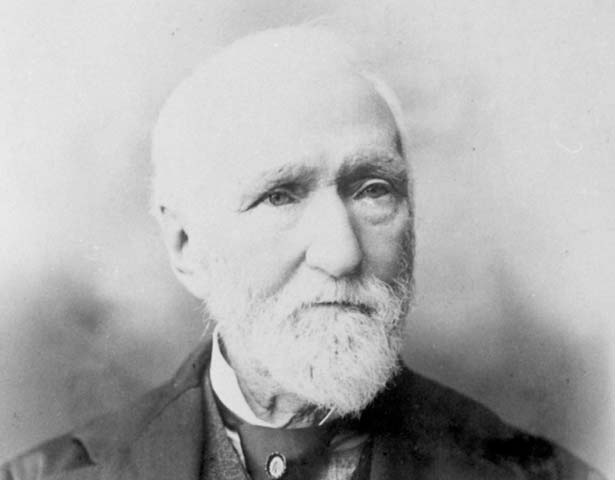
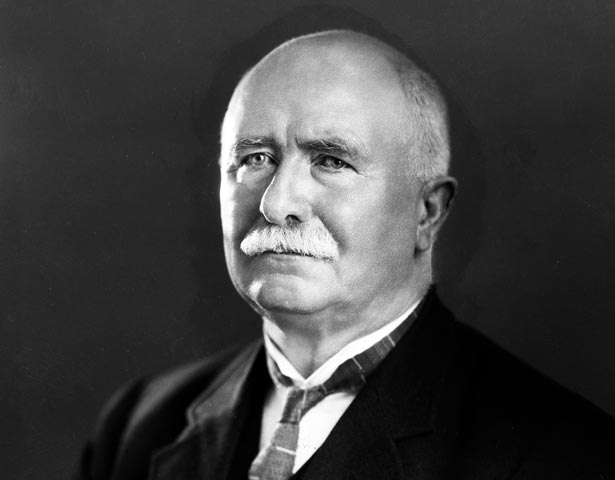
The 19th Prime Minister of New Zealand was William Massey who was born in Limavady, Derry in March 1856. He was a member of the Reform Party, a political force he helped to found, when he became PM in 1912. Born into a farming Presbyterian family, the family moved to New Zealand in October 1862 without young William who remained in Ireland to complete his education. He followed the family over to the far side of the world in December 1870.

He became involved in local politics through the local school board before being elected in an 1894 by election for the constituency of Waitemata before contesting the 1896 General Election for the neighbouring constituency of Franklin which he represented until his death in 1925.

After founding his reform Party in 1909, they became the largest party after the 1911 General Election but the incumbent Liberal Party remained in power with the support of Independents. The Liberals lost a vote of confidence in Parliament and Massey was invited to form a new administration and officially became Prime Minister on July 12th 1912. His first years in power were a period of great industrial unrest and his use of force to break strikes did not endear him to either his electorate or party colleagues but like many other politicians across the world the intervention of the First World War diverted attention from domestic matters. In the 1914 General Election no party won enough seats to be effective as a Government and Massey invited the leader of Liberal Party Joseph Ward to be party of a national unity Government in time of war.

Massey signed the Versailles Peace treaty on behalf of New Zealand at the end of the war. With war at an end the unity coalition fractured and in the 1919 General Election despite the rise of the new Labour Party, Massey and his Reform Party won a majority. He governed a troubled New Zealand both socially and economically until the 1922 General Election where he failed to win his majority winning just 37 of the 80 available seats but clung to power with the support of Independents.

His health deteriorated in 1924 and he passed away in 1925. 

Thursday, January 11, 2018

Irish Statesmen Abroad - The Series

The 1916 Easter Rising generated a generation of Irish leaders and statesmen but as a small island we have punched well above our weight providing statesmen for nations across the world. This series published everyday over the next two weeks looks at their stories.

Episode One - Great Britain

Two Irish born men have served as Prime Minister of Great Britain since the role was created in 1721. At the time when they were in office their title included Ireland.

LORD SHELBOURNE

Born William Fitzmaurice in the Fingal area of North County Dublin, on the death of his maternal uncle Sir William Petty, the family inherited the title of The Earl of Shelbourne and later William took the Petty family surname replacing Fitzmaurice. He spent many of his early years living near Ardfert in County Kerry. He joined the army and served with distinction in Germany during the Seven Years War. When his military career ended he assumed the family’s seat in the House of Commons for the constituency of Chipping Wycombe. Following the death of his father he entered the House of Lords.

In Westminster although seen as a shrewd politician with lofty ambitions, he found himself on the opposition benches and at the time advocated the controversial policies religious tolerance and free trade. He led the opposite for over a decade and was an outspoken opponent of the war with the future United States of America.

In March 1782, Shelbourne was appointed Home Secretary in the administration of Prime Minister Charles Watson Wentworth, The 2nd Marques of Rockingham but following the sudden death in July of the same year, he was appointed as a Prime Minister. During his tenure in the office he secured peace with the U.S., France and Spain. As part of the peace agreement with the U.S., the Treaty of Paris was rejected by Parliament and in April 1783, he resigned from office.

Shelbourne married twice, first in 1765 to Lady Sophia Carteret who died in 1771 and then to Lady Louisa Fitzpatrick in 1779. He was created a marquis in 1784, assuming the title of 1st Marquis of Lansdowne. He died in 1805 and was succeeded by his son John, 2nd Marquis of Lansdowne. The Dublin Four roads of Shelbourne Road and the adjacent Lansdowne Road home of the Aviva Stadium are named as the first Irish born Prime Minister of Great Britain.

DUKE OF WELLINGTON
  
Arthur Wellesley was born at 24 Merrion Square part of the Merrion Hotel today and opposite Government Buildings. The second tallest obelisk in the world after the Washington Memorial in DC located in Dublin’s Phoenix Park commemorates his death after a stellar military and political career better known as the Duke of Wellington.

Wellesley was born on May 1st 1769. After a schooling that included a stint at Eton for three years from 1781, Wellesley returned to Dublin having joined the army in 1787 working as an aide de camp in Dublin Castle. He was a socialite and lost a lot of money gambling. In 1790 he was elected  as an MP to the Irish House of Commons for Trim in County Meath close to the family home of Dangan Castle.

His contributions in Parliament were few and far between, making him the perfect candidate for today’s Dail Eireann. In 1796 just before revolution engulfed Ireland, Wellesley departed to fight in India. Throughout his military career he fought in over sixty battles across various continents. In 1806 after returning from India he was elected to Westminster as MP for Rye. In 1807 he was back in Ireland having been appointed Chief Secretary, the British political leader in Ireland under the Viceroy of the day the Duke of Richmond and he also had married Catherine Pakenham with whom he had two sons but the marriage regarded as loveless and the couple spent most of the lives living separately. 

His global fame would arrive in 1815 when he led the British army to success over Emperor Napoleon at the Battle of Waterloo. Wellesley commanded a multi national force as they took on Napoleon who had regained power after escaping from Elba. The British/Dutch/Belgian/Germany/Prussian force numbered 110,000, 26,000 of whom were British, one third of them were Irish born soldiers. The cost in lives on both sides was sixty five thousand dead.

A year later the newest pedestrian bridge over the River Liffey was named the Wellington Bridge in his honour, the once tolled bridge it is now colloquilly known as the Halfpenny Bridge. And of course the wellington boot which were specially made for him was named after him now a stable part of the fashion of rural Ireland, the ‘wellie’.

He first assumed the mantle of Prime Minister as a member of the Tory Party from January 22nd 1828 to November 16th 1830.   He oversaw the introduction of Catholic Emancipation in Ireland dismantling the hated Penal Laws. His second tenure began on November 14th 1834 only holding office on a temporary basis as a replacement for Robert Peel for a month. He also served as Foreign Secretary, Home Secretary, Minister for War and Leader of the House of Lords.
He died on September 14th 1852 and given a state funeral in London.
acres of land. 

Tuesday, August 29, 2017

Multi Racial 1916 Easter Rising

While much has been written the multi-national makeup of both sides of the battles during the 1916 Easter Rising very little has been written on the multi racial make up of forces especially on the British side.

When the battle between the Michael Malone led group of rebels at Mount Street Bridge and the arriving reinforcements of the Sherwood Foresters ended and the general surrender order was delivered to DeValera at Boland's Mills, the prisoners from the 3rd Battalion of the Irish Volunteers were marched not into the city centre with much of the other forces but out towards Ballsbridge and the grounds of the RDS.

According to Andrew McDonnell of Rathgar, Dublin in his witness statement.

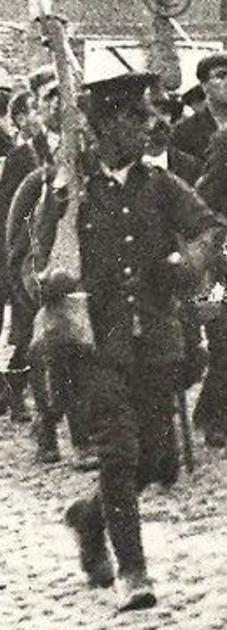
We were left in the stalls on the damp ground for some days. Meals were a movable feast: some days we got food and on others we got none. We were taken to the toilet under armed escort. This was at the end of the road near the gate leading on to Simmonscourt Road. We were objects of interest to the British troops who were in the stables opposite and came to grin at us over the half door of the stall. One of the British soldiers was black, a negro and his broad grin was most annoying until a well aimed tobacco spit made him give the half door a wide berth.
It must have been a strange sight for the exhausted combatants to espy a coloured gentleman in British military uniform in what at the time would have been a very white almost Anglo Saxon island.

Stephen Bourne in his book Black Poppies which dealt with the subject of Black servicemen in the British Army during World War One remarked
The near-total exclusion from our history books of black servicemen in the First World War is shameful…. Some black servicemen made the ultimate sacrifice … and like Walter Tull, died on the battlefields but with the passing of time, with the exception of Tull, the contributions of black servicemen have been forgotten.
The main protagonists of World War One all had their colonies and many of the British servicemen of colour were from the Caribbean so it is probably that the soldier at the RDS especially with his happy outlook was most likely from the opposite side of the Atlantic. By the end of WW1, 15,000 West Indians had joined and served in the British Army. As rebels are marched along the quays of the River Liffey towards ship in Dublin port to take them to prison and internment camps a photograph taken as they crossed O'Connell Bridge may have snapped that very same British soldier acting most likely as an ADC to his commandant on horseback.


Monday, July 3, 2017

Irish born Statesmen Abroad - NEW ZEALAND

Much has often been written about the ancestral connections of US Presidents with Ireland but Irish citizens have travelled the world becoming much loved and treasured statesmen in other nations. Ireland has produced three Irish born Prime Ministers of New Zealand. These are their stories.

DANIEL POLLEN

On July 8th 1875 Daniel Pollen became the Prime Minister of New Zealand. Daniel was the son of Hugh Pollen, a dock master at the mouth of the newly opened Grand Canal as it entered the River Liffey and Elizabeth O’Neill. Daniel was born on June 2nd 1813 when the family lived in what later became known as Pollen Cottage in Ringsend. Hugh Pollen received both the house and an annual salary of £100 per annum for his role as dock master.

Little is known about the early part of his life, but it is supposed that he grew up in Ringsend before emigrating to New Zealand in 1840, shortly after his father died in 1837 and the role of dock master and use of the house was taken over by Thomas Pollen, brother of the late Hugh. He arrived at the Bay of Islands settling in a town called Parnell near Auckland which probably made him feel right at home. He practiced as the local doctor but Daniel also became actively involved in politics with the formation of the Auckland Province in 1852 and was well regarded as a great debater and famous for his wit.

Two years after he was appointed the local coroner in 1846 he had married Jane Henderson a daughter of a Royal Naval officer and they went onto to have four sons and four daughters. Pollen entered politics first serving on the local provincial council representing Auckland East and then became a member of the New Zealand Parliament on May 12th 1873.  He rose through the political ranks and served in the Government of Julius Vogel as Colonial Secretary but when that Prime Minister left New Zealand to travel to Great Britain, Daniel Pollen from Ringsend in Dublin was appointed July 6th 1875 as Prime Minister of New Zealand. He held the position until the return of Vogel on February 15th 1876 when he returned to the position of Colonial Secretary and continued in that position under the following Prime Minister Harry Atkinson before he retired from politics.

Pollen died at his residence ‘The Whau’ in Avondale in 1896.

JOHN BALANCE

The 14th Prime Minister John Balance was born in Ballypitmave near Lisburn in County Antrim in March 1839. Born into a farming community to father Samuel, John Balance was the eldest of eleven children. As an eighteen year old he headed for Belfast City before crossing the Irish Sea to live in Birmingham. While there in 1863 he married a butcher’s daughter Fanny Taylor. His new bride became ill and the decision was taken in 1866 to immigrate to New Zealand where Fanny’s brother lived.

Once in New Zealand after a brief period as salesman he studied to become a journalist and from journalism he found his way into local politics. The move for the Balance couple down under proved futile as two years after their arrival down under Balance’s wife passed away. Two years later he married Ellen Anderson and the couple adopted a daughter Kathleen.

He was first elected to parliament in 1879 only to loose his seat in the subsequent election by just four votes when a horse drawn coach shed a wheel and seven of his supporters inside failed to register their vote. He won the seat back in 1884 and joined the Julius Vogel cabinet as Minister for Native Affairs. Out of Government, Balance accepted the role as leader of the then opposition Liberal Party. When the Government of Prime Minister Atkinson resigned, Balance became the Prime Minister in January 1891.

As Prime Minister he attempted to turn his Liberal party into a nationwide party rather than just regionally based. He was not known as a charismatic leader or a good public speaker, he was described as honest, courteous and displayed great patience and integrity. His wife became a leading figure in the fledgling feminist movement in New Zealand. His success as a Prime Minister was short lived as he developed cancer and passed away on April 27th 1893 receiving a state funeral in his home town of Wanganui. His wife Ellen outlived her husband by forty two years. 

WILLIAM MASSEY

The 19th Prime Minister of New Zealand was William Massey who was born in Limavady, Derry in March 1856. He was a member of the Reform Party, a political force he helped to found, when he became PM in 1912. Born into a farming Presbyterian family, the family moved to New Zealand in October 1862 without young William who remained in Ireland to complete his education. He followed the family over to the far side of the world in December 1870.

He became involved in local politics through the local school board before being elected in an 1894 by election for the constituency of Waitemata before contesting the 1896 General Election for the neighbouring constituency of Franklin which he represented until his death in 1925.

After founding his reform Party in 1909, they became the largest party after the 1911 General Election but the incumbent Liberal Party remained in power with the support of Independents. The Liberals lost a vote of confidence in Parliament and Massey was invited to form a new administration and officially became Prime Minister on July 12th 1912. His first years in power were a period of great industrial unrest and his use of force to break strikes did not endear him to either his electorate or party colleagues but like many other politicians across the world the intervention of the First World War diverted attention from domestic matters. In the 1914 General Election no party won enough seats to be effective as a Government and Massey invited the leader of Liberal Party Joseph Ward to be party of a national unity Government in time of war.

Massey signed the Versailles Peace treaty on behalf of New Zealand at the end of the war. With war at an end the unity coalition fractured and in the 1919 General Election despite the rise of the new Labour Party, Massey and his Reform Party won a majority. He governed a troubled New Zealand both socially and economically until the 1922 General Election where he failed to win his majority winning just 37 of the 80 available seats but clung to power with the support of Independents.

His health deteriorated in 1924 and he passed away in 1925.