 |


‘Sean Lemass stood up in Leinster House and pleaded
for support of Irish political prisoners.’
In the mid-19th century Richard Brady built a terrace of four
houses and named them Leinster Terrace, Irishtown. Numbers one to three were
houses while number four was opened as a public house. Today the terrace is no
more having fallen into disrepair in the late 19th century and
demolished to make way for St. Matthews Girls national school that was opened
in 1903. In 1854 Brady sold the terrace as he intended to emigrate. In 1858 the
pub at 4 Leinster Terrace was put up for sale with Arthur Torkington of Dawson appointed
as the auctioneer. It was purchased by Edward Walsh but by August 1866, the
Dublin Evening Post reported Walsh was insolvent,
‘Edward Walsh, Cook-street, city Dublin, web and tape
manufacturer, and linen and cotton yarn merchant, sometime of Irishtown, county
Dublin, vintner.’

This had been brought about by a slander court case in June 1865. The
Dublin Evening Mail reported,
‘Patrick Hughes v. Edward Walsh. In this case the action was brought to recover damages for oral slander, libel, and malicious prosecution. The defendant complained that the plaintiff said of him, a I was at loss to know his residence or else should have issued summons against him for passing a bad shilling on my wife." Also, that the defendant spoke and published of the plaintiff, "You are forger and swindler; you passed bad shilling on wife and, further that the defendant caused a summons be issued against the plaintiff, and therein charged him with having feloniously uttered a base coin to the wife of the defendant, which summons was heard before a magistrate, and dismissed. The plaintiff alleged that by reason of the defendant's conduct and proceedings towards him he had been injured in his reputation and claimed £500 damages. The plaintiff is a commercial traveller, and the defendant, a publican, carrying on business at Irishtown. The defendant pleaded that he did not speak or write the words in the defamatory sense alleged, and that he did not do the acts complained of maliciously. The Jury found for the plaintiff on all the issues. Damages £20.’


In 1868 his name was
attached to a petition for the release of political prisoners many of whom had
been arrested following the failed 1867 Fenian rebellion. The Lemass family
also had a lucrative side line operating the catering franchises for events
including the popular Metropolitan Regatta held in Ringsend on the River
Liffey. Joseph died in 1874 and the pub was put up for sale. The pub was now
listed as 57 Leinster Terrace or Irishtown Road as the area expanded and new
houses were being built. Joseph Lemass died on 8 October 1885 when he was 46
years old, his wife Eliza died the following March, she was just 39 years old
and they left seven surviving children without parents. John Lemass died on
April 10th 1916. Their cousin Sean Lemass, a veteran of the 1916 Easter Rising
would become Ireland’s 4th Taoiseach serving the highest level of Government
from June 1959 to November 1966. He was also the father in law to Charles
Haughey another future Taoiseach. He died in 1971.


The pub was purchased by Michael Lenehan. With the lease coming to an end in 1890, Michael Lenehan purchased the pub across the road from his known as The Eagle Tavern, known today as the Vintage. Without the need for two pubs, the pub at 57 Leinster Terrace was abandoned and fell into disrepair, listed in Thoms Directory in 1898 as vacant. The terrace of four houses were emptied and the terrace demolished. The land was purchased by St. Matthews Church of Ireland parish whose church was just across the road. In 1903, the St Matthews Girls national school was opened to compliment the boy’s school that was located on the corner of Church Avenue.

Throughout the latter part of the 19th century following the
introduction of new public house licensing laws in 1850, there was fifteen
premises licensed to sell alcohol in the Irishtown area, that was the trio of
streets Irishtown Road, Bath Street and Pembroke Street.
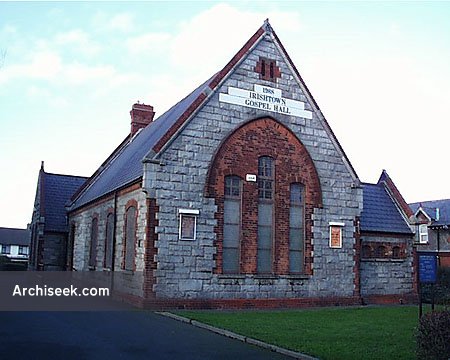


Brian Siggins was a well known local historian in the Sandymount and Ringsend area. The former teacher in Ringsend Tech, passed away a few years ago but his Gerard, knowing of my interest in public house histories has passed on some of his Dad’s archives to me. One of the recent deliveries was this unique piece of Irish pub history, an original pub licence transfer from Laytown in Co. Meath in 1895. This is the front and back of the licence. The small village was famous for its beach horse racing and had thrived with the opening of a station in the village on the new Dublin to Drogheda railway line.

The pub, The Seaview Tavern, was in 1893 owned by John Joseph Curran. Curran was born on June 1st 1865 to a Drogheda merchant and William Curran and his mother Elizabeth nee McGuinness.[1] With the assistance of his father, a very young Joseph Curran moved a few miles south seaside town of Laytown and became a publican purchasing the licensed premises that was being operated by John Bonham. The pub he bought was already a famous tavern based on the Irish Sea coast, featured in a painting that currently is available to view in the National Library. It was not long before the Curran’s new pub was appearing in the newspapers. This is from the Freeman’s Journal in 1885.

The pub was also a venue for a number of inquests when people were drowned in the nearby sea, whether swimming or in fishing accidents. In 1893, Curran decided to sell the Seaview Tavern and advertisements appeared in the newspapers.

The following year it was sold to Philip McArdle. It was the transfer of licence that features at the top of this post. While McArdle advertised his re-opening of the Seaview Tavern,

Although just like Curran, the local constabulary were watching and shortly after taking over McArdle found himself in court after a raid for afterhours drinking.

Curran returned to the town of his birth Drogheda where he purchased a pub at 3 West Street which had been owned by the Moran family. This is an advertisement that featured in the Drogheda Independent for his new pub in Drogheda.

Joseph Curran is listed in the 1911 Census as being married to Elizabeth (nee Hughes) who was twelve years younger than her wine Merchant and Grocer husband. They had married on June 7th 1906 in Ardcath, Co. Meath. Joseph Curran died on July 14th 1934 in a Dublin nursing home. His wife had predeceased him in April 1929, aged just forty nine. They had three children Mary (born May 1908), William (born May 1910, died October 1918) and Gerard (born 1917).

The Seaview Tavern continued to trade in Laytown
firstly changing names to the Seaview Bar which was successfully run by Eamon
Lyons for many years. It was later in 1996 to be renamed the Coast Inn by Benny
McLoughlin.


PRESS RELEASE
For Immediate Release
Heritage Week 2022 is coming
to Ringsend with the ‘From Cromwell to Today’ walking tour. This is the unique
story of the history of the public houses in village of Ringsend and their
colourful tales. This walking tour of approx 1hr will take you on a journey
from the once 10 pubs in the village of Ringsend to today's 3. Closed and wiped
out by Cromwell, the pubs recovered, they helped to ferment revolution, they
survived a temperance movement and adapted as laws and habits changed. On the
tour, you'll hear the real story of Ringsend's pubs, and the characters who
owned and frequented them. Plus we learn about the history of Ringsend and why
streets like Whiskey Row have vanished.
The tours will depart
Saturday 13th (2pm) & Sunday 14th (3pm) August plus Sunday 21st (1pm) from outside
the Ringsend Library and they are Free of Charge.
The Ringsend Tour follows
the extremely successful ‘History of the Sandymount Pubs Walking Tour’ in 2021
and the history evening that celebrated the centenary of O’Reilly’s pub in
Sandymount.
The 1916 Easter Rising
Coach Tour was founded in 2011 and has guided thousands of guests through the
unique history of Ireland’s revolutionary period. This award winning company has
more recently developed a unique way of telling the stories of the Irish
licensed trade.
BOOKINGS MUST BE MADE IN
ADVANCE AT
1916easterrisingcoachtour@gmail.com
Further information:
https://www.heritageweek.ie/event-listings/the-history-of-the-pubs-of-ringsend-from-cromwell-through-covid
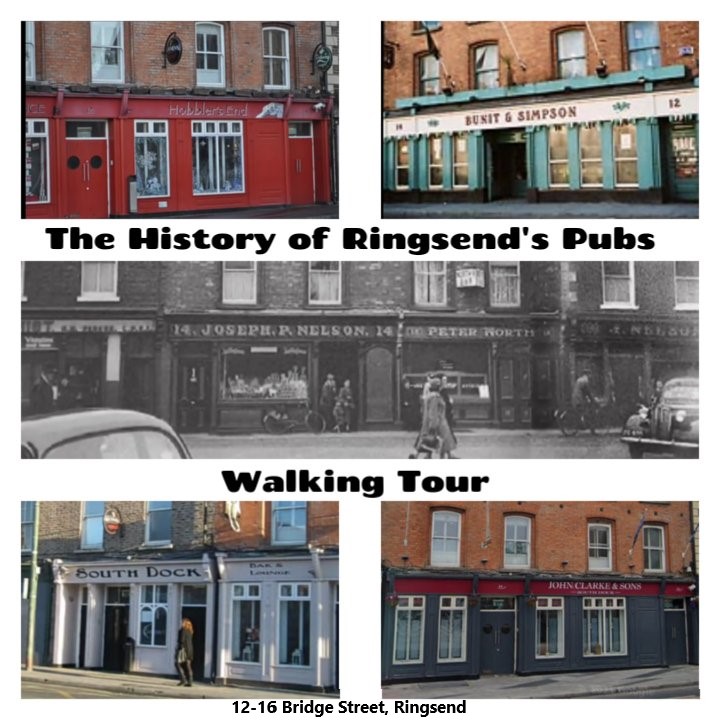
Welcome to part two of our look at some of the Pubs of Ringsend. In 2022 a Walking Tour will commence bringing you the colourful history of the many pubs and tales of Ringsend or Raytown as the locals know it. There were some early public houses in Ringsend even in the days when Oliver Crowell landed there in August 1649 with twelve thousand troops. Despite his proclamation against drink, pub life continued. Having been seasick on the journey across the Irish Sea, Cromwell and some of his Lieutenants went into the first tavern they met in Ringsend, plied themselves with drink and then closed all the taverns in the village.

It was said that at one
stage by the mid eighteenth century every third house in Ringsend was an
alehouse. One of the earliest infamous pubs was The Kings Head Tavern on
Thorncastle Street. In 1683 the tavern was run by a man called Brennan and
found itself under surveillance from the Crown Forces when three cousins of his
stayed in the Tavern. The Brennan’s Patrick and James from Kilkenny had been on
the run after a series of highway robberies and were the number one target of
the Chief Justice John Keating. They had been arrested for murder and robbery,
tried, found guilty and sentenced to hang but as they reached the scaffold they
were rescued by compatriots and went on the run. Having stayed a number of
nights enjoying the hospitality of the Tavern, they became aware that they were
being targeted by spies and the brothers, along with a young cousin Daniel,
slipped quietly out to a ship in the Basin and escaped to Britain. They arrived
in Chester but unluckily for them, one of their victims recognised the robbers
and they were arrested. They bribed their warders and escaped once more and
made their way back to Ireland where they stayed at liberty in their native
Kilkenny.
In 1698, British writer
John Dunston travelled throughout Ireland and as his tour ended, he wrote that,
‘I
had very agreeable company in Ringsend and was nobly treated at the King’s
Head.’
By the mid eighteenth century another public house was enjoying success. Known as The Sign of the Good Woman it was operated by a Mrs L’Swaire. It made its name with food and drink and was a popular for its Poolbeg Oysters. The Oysters were fished for and supplied at the time by Messers Bunit and Simpson, whose name would later adorn a pub for many years in the twentieth century on Bridge Street in Ringsend.

The name of a Ringsend
tavern known as the Good Woman would also appear in James Joyce’s work
Finnegan’s Wake[1].
In it he wrote
‘and
the foretaste of the Dun Bank pearl mothers and the boy to wash down which he
would feed to himself in the Ruadh[2] Cow at Tallaght and then
into the Good Woman at Ringsend and after her in at Conway’s Inn at Blackrock.’
In 1765 another popular
Ringsend tavern was The Sign of the Highlander[3] which was run by Mrs
Sherlock. The pub had a billiards table which you could play for two pence and was
overseen by Mrs. Sherlock who acted as the marker for the games, the holder of
any bets and as an adjudicator for any disputes that may arise. Her brother had
emigrated to London where he was known as a great swordsman
‘who
many years before had been victor in every broad-sword contest of consequence,
at a time when the skilful management of that weapon was considered of
importance in London’ [4]
One publican who bettered himself after his time trading in Ringsend was Richard Hill. In October 1781 he announced through adverts in the newspapers he was opening a new tavern at No.2 Crow Street off Dame Street. He had been running a tavern in Ringsend known as Clements for a number of years. By June 1782 he was off loading his premises in Ringsend and it was put up for lease. It was described as having ‘stables, a good kitchen, garden and a large assembly room, all in good order.’ Hill had taken over from James Clements who had traded since 1777. Both men were ship builders along the River Dodder and the River Liffey which was common that they also owned a local tavern where their workers not only received their wages but then encouraged to spend them. Clements went bankrupt and Hill took over the running of the tavern with little or no experience as an innkeeper.

The nearest pub to the
bridge crossing the River Dodder in 1788 was Harrison’s Tavern and the Dublin
Chronicle reported on September 23rd 1788 that being exhibited at
the tavern was ‘a radish of surprising magnitude, it measures in length one yard
and a quarter and in circumference eleven inches and a quarter.’
By the early 1800’s the
Ringsend Tavern on Bridge Street was a popular eatery. Originally run by John
Howard in 1805 the running of the pub was in the hands of Mr. and Mrs. Madden. The
pub was located approximately where Clarke’s public house is today. An advertisement
in the Saunders Newsletter stated,
‘Howard’s
is fitted in an elegant manner where clubs, parties etc can be accommodated in
the shortest notice with best dinners in season and with Wines, Malt Liquors and
spirits of superior quality.’
It also importantly added
for the time,
‘Excellent
accommodation for horses and carriages’
Howard had been a partner of Thomas Bray in the prosperous Ringsend Salt Works until a legal dispute erupted between Howard and Bray’s brother Michael[5].

In the next episode we
will be looking at the pubs popularly remembered at Fitzharris’s which was located
near the bridge in a building now occupied by a pizza firm.
Check our social media platforms for dates and booking details for the forthcoming Walking Tour.
[1]
Published 1939.
[2]
Irish word for Red
[3]
Recollections of the Life of John O’Keefe, Volume One
[4]
The Annals of Booterstown to Donnybrook
[5]
The Dublin Saunders Newsletter

Coming in 2022, following
the successful ‘The History of Sandymount’s Pub Walking Tour’ and ‘The Pubs of
Rathmines Tour’, we will be bringing you ‘The Pubs of Ringsend Heritage Walking
Tour’. To whet your appetite for some of the stories and tales you will hear,
we will bring you over the coming weeks some of the histories of the pubs no
longer open. Today we will be starting with North’s public house, in coming
weeks we’ll bring you the histories of The Sign of the Highlanders, The Old
England Tavern and the Hobbler’s End.
Now just a memory, but for many of an older generation in Ringsend and Irishtown, Peter North’s pub on Bridge Street in Ringsend brings back happy memories. Alas long gone but if you walk through the lounge door of John Clarke’s public house today you will have walked the route of many of North’s customers.

Peter North was a popular
publican who received extensive coverage in Irish newspapers in October 1967.
Peter was celebrating his hundred birthday and was described in the Irish Press
as ‘probably the oldest publican in the country’. While still living above the
pub, he had retired from serving pints to the locals just three years earlier
as his health began to fail.
He had been born on Upper
Baggot Street and served his first pint, aged sixteen, in the pub that had been
opened by his father Morgan North in Ringsend. A lively sportsman, Peter, along
with his brothers Francis and Bartle, played for the Isles of the Sea GAA
hurling club and they won the Dublin County Championship in 1890. Peter later
recalled,
‘it was some sight with 42[1] players on the field. There used to be some awful scrimmages.’

His brother Bartle was the first superintendent of the electricity generating station at the Pigeon House when it opened in 1904[2]. His son Bartle junior became a popular bookie in Ringsend with a shop on Fitzwilliam Street. Morgan North’s public house was located on the corner of Fitzwilliam Street and Thomas Street as it was known then, now known as Irishtown Road. The newspapers reported that in 1910 Peter North of 16 Fitzwilliam Street was fined by the courts for allowing children on his premises despite the fact that their mother was with them.

Today that former North public house is home to the National Council of the Blind shop. Morgan’s only daughter Mary Catherine married Valentine Nelson, the son of another Ringsend publican Joseph Nelson. The Nelson’s also ran a butcher shop on Bridge Street. In the early twentieth century, following a Pembroke Estate decision to renovate many of the properties on the part of Fitzwilliam Street that connected with Cambridge Avenue, by 1916 the North’s had moved their public house to a building next door to the Nelson’s on Bridge Street. Peter often fell foul of the licensing laws and was raided and fined on a number of occasion for serving outside permitted hours including on Good Friday 1940 after which he was fined £2 and had his license endorsed. The following June he was raided again for serving afterhours with thirteen customers on his premises. He was fined twenty shillings and was lucky not to lose his license.


The pub on the Fitzwilliam Street had seen previous owners Michael Holden in the 1830’s and Edward Smith in the 1850’s before the North’s arrival. Following Morgan North’s premature death at the age of just forty five, his pub’s license was operated by Anne Lowe who seemingly employed the young Peter North as a barman until he became of age to run the pub himself.

Having celebrated his
centenary in October 1967, just three months later in December the popular
local Ringsend publican passed away peacefully and enjoyed one of the biggest
funerals seen in the south Dublin suburb. When both Nelson’s[3] pub and North’s pub were
sold they were joined into one pub with a bar and lounge owned by the popular
Dublin publican family, the Dwyer’s. Today
the pub is occupied by John Clarke and family who had traded for many decades
successful just up the road in Irishtown.

[1] 21
per side was replaced by the current 15 a side
[2]
Died September 1936
[3]
Sold 1968


