BOOK TODAY

BOOK TODAY
AWARD WINNING TOUR IN DUBLIN

EASTER RISING COACH TOUR

EASTER RISING COACH TOUR

ATTENTION COACH and TOUR OPERATORS

ATTENTION COACH and TOUR OPERATORS
Our friendly and excellent guides are available as Step On Guides for any visiting tour or coach operators who may like a unique, entertaining and educational tour of Irish History and the events of Easter Week 1916.
Showing posts with label Dublin 4. Show all posts

Thursday, October 12, 2023

The Pub at No24 Bath Street, Irishtown.


No 24 Bath Street

The Isles of The Sea were one of the most successful Dublin GAA clubs in the early part of the twentieth century. Based in the Ringsend and Irishtown area The club was founded in the late 1880s in the very early years of the GAA. They won the Dublin Senior Football Championship on three occasions 1890, 1895 and 1901. Their players from the club backboned the Dublin team that won the 1901 Senior Football title, with that final played on 2 August 1903. A number of club meetings were held at No.24 Bath Street, a popular bar in the Irishtown area. A year earlier advertisements noted that meetings of the Leinster Senior League would be held at No.24 Bath Street.


Back in 1870, James Dunne was the publican at No.24 and he was followed by his widow Elizabeth and later by his sister in law Mary Dunne. Elizabeth was originally from Haddington Road, died in 1894.


The Dunne’s were followed in 1892 by James Crutch, the pub being sold in September. Liverpool born Crutch was described in the 1901 & 1911 census as a ‘Clerk’. He was married to Louth born Esther Leslie. The couple lived on Sandymount Green for many years before his death


James Crutch was followed in 1897 as licensee by Anne Jane Graham. Anne Jane Leslie was born on August 27, 1859, in Dundalk, Louth, Ireland, her father, Richard, was 24, and her mother, Esther, was 29. She married Robert Ritchie Graham on November 27, 1876 and they had nine children over a period 19 years. She had three brothers and two sisters one of whom, Esther was married to the previous licensee James Crutch. Robert was a assistant supervisor at the GPO in O’Connell Street. While the pub was located on Bath Street, the Graham family lived on nearby Londonbridge Road.


In September 1899 Patrick Hughes took over the running of the pub but was gone within a year to be replaced the following September of Mrs. Mary Bourke. 


The 1901 Census listed Mary Bourke as being a widow and a ‘vintner’ with Edward Lemon listed as a ‘assistant’ as he worked in the bar. Lemon according to the Dublin City database lived as a lodger at 30 Harcourt Street.


In 1903, No.24 was in the hands of Laurence Donnelly. Prior to his arrival on Bath Street, the then twenty seven year old Carlow born Donnelly had been a barman in Fitzharris’s pub on Bridge Street in Ringsend. Donnelly’s remained in business for over a decade before the pub finally closed its doors to the public.


Wednesday, July 20, 2022

PRESS RELEASE - HERITAGE WEEK 2022, THE HISTORY OF RINGSEND PUBS TOUR


PRESS RELEASE

For Immediate Release

Heritage Week 2022 is coming to Ringsend with the ‘From Cromwell to Today’ walking tour. This is the unique story of the history of the public houses in village of Ringsend and their colourful tales. This walking tour of approx 1hr will take you on a journey from the once 10 pubs in the village of Ringsend to today's 3. Closed and wiped out by Cromwell, the pubs recovered, they helped to ferment revolution, they survived a temperance movement and adapted as laws and habits changed. On the tour, you'll hear the real story of Ringsend's pubs, and the characters who owned and frequented them. Plus we learn about the history of Ringsend and why streets like Whiskey Row have vanished.

The tours will depart Saturday 13th (2pm) & Sunday 14th (3pm) August plus Sunday 21st (1pm) from outside the Ringsend Library and they are Free of Charge.


The Ringsend Tour follows the extremely successful ‘History of the Sandymount Pubs Walking Tour’ in 2021 and the history evening that celebrated the centenary of O’Reilly’s pub in Sandymount.

The 1916 Easter Rising Coach Tour was founded in 2011 and has guided thousands of guests through the unique history of Ireland’s revolutionary period. This award winning company has more recently developed a unique way of telling the stories of the Irish licensed trade.

BOOKINGS MUST BE MADE IN ADVANCE AT

1916easterrisingcoachtour@gmail.com

Further information:

https://www.heritageweek.ie/event-listings/the-history-of-the-pubs-of-ringsend-from-cromwell-through-covid


Saturday, January 22, 2022

The Pubs of Ringsend Walking Tour - Episode Six - From Ulysses to the Oarsman in the heart of Ringsend


The next pub on our travel through the history of Ringsend’s pubs will take more than one post to cover. Number Eight Bridge Street Ringsend is today The Oarsman but it has a wonderful and colourful history. The first time that alcohol was served here was in 1816. In the 1830’s the publican delivering service was John Madden. By 1837 he had been replaced by John Gilligan who was in turn succeeded by his wife Anne Gilligan up to 1860 when William James Tunney took over. Tunney lived with his family at 35 Bath Avenue and would later add to his portfolio by buying 10 Haddington Road which is now Smyths public house. His brother Michael also owned a pub in Ballsbridge. It was Tunney who installed the artistic façade and a pediment that displays a Irish round tower, a Celtic high cross and an Irish Wolfhound. The stuccoworks company of William Burnett and James Comerford created the stucco to dress up a building with the exaggerated ornamental impulse that was a feature of the Celtic Revival. At roof level on the Oarsman, within a central roundel flanked by urns, there is a stuccoed escutcheon displaying a collection of nationalist symbols – a round tower and a Celtic high cross guarded by an Irish wolfhound. A harp once surmounted the arrangements atop the now empty plinth at the apex. This is Dublin’s last surviving example of stucco art being used to portray romantic nationalism in a form that was once popular on public houses. Burnett and Comerford would also famously design and build the façade of the famous Irish House on the corner of Woodquay and Winetavern Street, sadly demolished now.


Tunney’s also found itself into one of the twentieth centuries greatest literary work, Ulysses by James Joyce first published in 1922. Set in 1912 Dublin, it follow one day in the life of Leopold Bloom as he crosses the city including a visit to Ringsend. According to the Ulysses guide,

‘Ulysses depicts several such women: the "bent hag" in Calypso that Bloom sees in front of "Cassidy's, clutching a naggin bottle by the neck"; Mrs. Dignam in Circe, "her snub nose and cheeks flushed with death talk, tears, and Tunney's tawny sherry"; Molly in Penelope, who thinks, "I’ll have to knock off the stout at dinner or am I getting too fond of it the last they sent from O’Rourke’s was as flat as a pancake." In these details Joyce shows women drinking from all the major food groups—hard liquor, wine, beer—and he shows public houses doubling as package stores. O'Rourke's is the pub that Bloom passes in Calypso, and Tunney's is mentioned twice in one section of Wandering Rocks, when Patsy Dignam thinks of his mother sipping "the superior tawny sherry uncle Barney brought from Tunney’s," and of his father's frequent visits to the pub: "The last night pa was boozed he was standing on the landing there bawling out for his boots to go out to Tunney’s for to booze more."


The pub also found itself in the records of the Bureau of Military History as a witness statement of Michael Noyk explained. It referred to a barman who worked in the pub Michael Vaughan.

‘The 4th witness, Michael Vaughan, who was afterwards killed during the Civil War at Leeson Street Bridge, said; He was an assistant in Tunney's public house. On the 21st November he went out about 9.30 to get a newspaper - "The Independent" - in the shop near him. He spoke to the man in the shop for about 4 minutes and then went back to his own shop to get his breakfast when he saw Whelan coining out of the chapel gate. (Tunney's is just opposite Ringsend Chapel). Vaughan bade Whelan the time of the day. crossed had crossed the street to speak to him and they spoke for about two or three minutes. Vaughan said he would have to be going as he had to be at Westland Row Mass at 10.30. Witness said a Mr. O'Connor introduced him to prisoner about three weeks before the 21st November. He added that the day was fixed in his memory by the deaths of the men who were killed that day.’


Michael Vaughan would leave the pub employ and join the new National Army. On June 29th 1922 he was killed in an ambush on Leeson Bridge when a grenade and shots were aimed at the car in which he was travelling. Clare born Patrick McCarthy whose address was given as The Shelbourne Bar, Bridge Street, Ringsend was awarded a military service medal for his service during the 1917-1921 revolutionary period as a member of K Company, 1st Battalion of the IRA Dublin Brigade.


William Tunney died on St Patrick's Day 1912 and for a number of years his family continued to run the pub into the early years if the new Irish Free State. It was eventually sold to Michael McCloskey, who’s later family members would run a pub for many years in Donnybrook. McCloskey called the pub the Shelbourne Bar due to its proximity to the Shelbourne sports ground on nearby South Lott’s Road.


Mr. Hugh McDermott presenting a cup to a winner owner at the Greyhound racing at Shelbourne Park

Following Michael’s death in January 1945, his widow Eleanor (also known as Ella) took over the running of the pub along with her son Michael Jnr. Ella died in 1954. The McCloskey’s then sold the pub to Hugh McDermott. McDermott was behind a scheme, who at the time was President of the Vintners association, that offered a scholarship to those who could not otherwise afford it, this included an extensive stay in the Gaeltacht. The pub was sold by the McDermott family and in the 1980’s Ballyconnell, Co. Cavan native Bob Prior and his wife Monica, owned both the Oarsman, as it had been renamed, and the Yacht on Thorncastle Street. Bob Prior had been an owner of the Boars Head on Capel Street prior to his arrival in Ringsend.


Today the Oarsman is a popular local pub in the heart of Ringsend offering a wide range of choice for both the drinker, diner and coffee connoisseur.


Sources
The Irish Newspaper Archives
The British Newspaper Archives
The late Brian Siggins courtesy of Ger Siggins
Archiseek
The National Archives
Hinde Postcards


Wednesday, December 8, 2021

The Pubs of Ringsend Walking Tour - Episode Four THE OLD ENGLAND TAVERN


Welcome to Episode Four of our series on the pubs of Ringsend. These stories will form the basis of the forthcoming The Historic Pubs of Ringsend Walking Tour in 2022 and a book on the history of the pubs in both Ringsend and Sandymount. Today we will look at the story of another long lost pub in the Village, ‘The Old England Tavern’.


Located at Number 6 Thorncastle Street, this pub began life as ‘The London Tavern’ in the early 1800’s. By 1850 it was in the hands of John Nickells (or Nicholls) and it was Nickells that renamed the pub as ‘The Old England Tavern’. There had been a previous incarnation of ‘The Old England Tavern’ for many decades at 10 Georges Quay but when it was sold in the 1840’s and renamed the tavern title became available.


In the 1870’s it was purchased by Patrick Mulholland. Mulholland was declared a lunatic, which was a nineteenth century name for an alcoholic. Following his death, ‘The Old England Tavern’ was run by his widow Mary. Mary died on July 29th 1884, following which her pub was put on the market by the executors of her will in November of that year. It was purchased by James P. Purcell, who within weeks of opening found himself in court on a charge of serving afterhours and was fined. Purcell obviously over-extended himself as he was declared bankrupt on December 14th 1886. On April 1st 1887 the pub was sold at the auction house of Frank Hodgens to James Byrne for £270 (£37,000 in today’s cash). Byrne stayed just five years in Ringsend before selling his pub to William McEvoy in 1892.


In 1906 the pub was purchased by Tipperary born Thomas James Carroll, the license being transferred from Joseph Mulholland into Carroll’s name. Carroll was a married man, having married Elizabeth from Kildare in 1900. On September 18th 1908, the pub was raided by the local police from Irishtown for serving afterhours after a number of men were spotted playing billiards in the pub after closing time. The last occupant of Number 6 Thorncastle Street was William Phelan but upon his death the pub was sold in January 1920. The pub was described as having a,

‘compact, well-appointed bar, bagatelle room, good cellarage, bottling store etc and four living rooms. The house has an entrance also from Fitzwilliam Street, which is a great business advantage.’


When the property was sold for £2,530, the license was allowed lapse and a grocery business was operated from the building. In recent decades, under various names the former Old England Tavern has been a chemist. In the next Episode we will feature one of the most fascinating pub history in Ringsend and so vast is that history that the story will be spread over three posts. We will begin next with the early history of the pub known today as THE OARSMAN.

Wednesday, December 1, 2021

The Pubs of Ringsend Walking Tour - Episode Three from Harrisons to Fitzharris to Domino's


 Welcome to part three of our look at some of the Pubs of Ringsend. In 2022 a Walking Tour will commence bringing you the colourful history of the many pubs and tales of Ringsend or Raytown as the locals know it. One of the now departed public houses in Ringsend but one of the most popular was known as Fitzharris’s for over a century. A popular place for the local dockers. Number 4 Bridge Street, now home to Domino Pizza’s, was also one of the earliest pubs in the village.


One publican who bettered himself after his time trading at 4 Bridge Street was Richard Hill. In October 1781 he announced through adverts in the newspapers he was opening a new tavern at No.2 Crow Street off Dame Street. He had been running a tavern in Ringsend known as Clements for a number of years. By June 1782 he was off loading his premises in Ringsend and it was put up for lease. It was described as having ‘stables, a good kitchen, garden and a large assembly room, all in good order.’ Hill had taken over from James Clements who had traded there since 1777. Both men were ship builders along the River Dodder and the River Liffey, which was common that they also owned a local tavern where their workers not only received their wages but then encouraged to spend them. Clements went bankrupt and Hill took over the running of the tavern with little or no experience as an innkeeper.

It was known as Harrison’s Tavern in 1782. The Dublin Chronicle newspaper reported on September 23rd 1788 that being exhibited at the tavern was ‘a radish of surprising magnitude, it measures in length one yard and a quarter and in circumference eleven inches and a quarter.’


By the early 1800’s the Ringsend Tavern, as it was now known, was a popular eatery. Originally run by John Howard in 1805 the running of the pub was in the hands of Mr. and Mrs. Madden. The pub was located approximately where Clarke’s public house is today. An advertisement in the Saunders Newsletter stated,

‘Howard’s is fitted in an elegant manner where clubs, parties etc can be accommodated in the shortest notice with best dinners in season and with Wines, Malt Liquors and spirits of superior quality.’

It also importantly added for the time,

‘Excellent accommodation for horses and carriages’

Howard had been a partner of Thomas Bray in the prosperous Ringsend Salt Works until a legal dispute erupted between Howard and Bray’s brother Michael[1].


In 1830, the pub was being run by John Eustace and his pub found its name in the newspaper for all the wrong reasons. John Higgins and George Eastwood were local fishermen who entered Eustace’s pub to have a drink. Eustace was also a fellow fisherman. The Dublin Observer then reported what happened next.

‘The deceased and Eastwood, the prisoner in custody for the murder, were fishermen living Ringsend, and had an altercation in the early part Saturday last, relative to some expressions which the latter (Eastwood) made use of towards a female member of the deceased’s family, which, however, were not much minded the latter, who offered shortly afterwards to shake hands with the prisoner, and have nothing more about the matter; but this was refused by Eastwood, who said on more occasions than one, ' I’ll have your life's blood, and make you drink before the day ends.” In the evening both parties met together in a public house belonging to a man named Eustace, of Ringsend, when, after sitting there a short time, and some conversation having arisen, during which reference was made to the original dispute, and the deceased again proffered the hand of friendship. Eastwood suddenly rose from his seat, and pulling out sharp pointed instrument, something like a dagger, plunged it into the body of his unfortunate companion between the fifth and sixth rib, and penetrated into the cavity of heart. The deceased bad only time to say (putting his hand upon the wound), He has done for me,” when he fell forward and immediately expired. His friends then brought the body to Jervis Street hospital.’

The Freeman Journal reported the testimony of the publican John Eustace,

'The prisoner (Eastwood) came in and commenced using irritating language to the deceased. Higgins desired him to go away, that he wished to have nothing to do with him. The prisoner still (continued to annoy him, when deceased gave him a shove. The prisoner then said, "1 will have satisfaction of you for that before I sleep.", This was about five o'clock. In a subsequent part of the evening, about an hour afterwards, deceased invited the prisoner to make it up, and asked him to take a drink of porter. His reply was, ‘No, I won't but I'll give you some of your own blood to drink before you go to bed.’ About seven o'clock witness joined the deceased (Higgins) in Eustace's public-house. Eastwood (the prisoner) was in the same room, but in a distant seat. He came over to where deceased and witness were sitting, and said to deceased, " You bloody villain, I'll have your life." Some words ensued, and deceased took the prisoner up by the collar and the leg and carried him over to the fire-place, where he laid him down, deceased observed, when he did so, " you see it is not worth my while to strike a boy like you;" deceased had his back turned to prisoner, coming back to his seat, when the later struck him in the chest deceased then observed, "Johnny, damn me but he has done for me, he has whipped it through me ;" deceased then fell without uttering another word; in the conversation that took place previous to deceased's lifting the prisoner over to the fire, the latter made some insulting allusions to the sisters of the former; the prisoner was tipsy at the time, he was more tipsy at the latter end of the dispute, when he struck the blow, than he was at the commencement, deceased was also a little " hearty;" he appeared to be some- what irritated when he lifted the prisoner off the ground.


Eustace’s son Joseph Junior then bought a pub on Thorncastle Street before his father sold the pub on Bridge Street.

In 1862 the pub was sold once again by the now owner Captain Sloan who announced that he was leaving to concentrate on other business interests. The pub was purchased by William Heapes who then left the pub to his son Joseph. His daughter Elizabeth married local shipwright James Barry. Upon the death of his father in law, Barry took over the running of the pub. The pub was now being run by Barry and now the Fitzharris name enters the story. Laurence Fitzharris, originally from County Carlow, was employed as a barman in the pub next door at Number Eight, rising to the role of manager. When the pub at Number Four was sold by the family of the late William Heapes in June 1895, Fitzharris purchased the pub and put his name above the door. 


In 1914, the police were attacked on Bridge Street in the aftermath of ill feelings after the 1913 Lock Out. The police reported that they were showered with glasses and bottles thrown from the upper floors of Fitzharris’s by customers without the knowledge of the owner. Laurence Fitzharris passed away in December 1920 leaving the family to run the pub. He missed out seeing his daughter Eleanor (also known as Lillie) marry Sir John Esmonde in 1922. Esmonde served both as an MP in the British Parliament and as a TD for Fine Gael in the Dail.

The Fitzharris Family as published by Martin Gueret

1948 was a traumatic year for the Fitzharris family. Mary (nee Moran from Wicklow), Laurence’s widow, passed away on January 7th 1948 and on May 22nd her youngest son Maurice also died. A relative, Maurice Gueret writing in Sunday Independent recalled his Uncle Maurice,

‘He was known in the locality as ‘The Hump' Fitzharris, for he was born with a hunched back, or acquired it when dropped as a baby. (There are two medical opinions on his story). Maurice was the baby of the family and, all his life, was very attached to his mother. In fact, he died just months after she did. ‘The Hump' was a cruel sobriquet, you might think, but Dockland could be an unforgiving place, and not a place for the sensitive soul.’


Following his passing, his sister Kathleen Butterly applied for the transfer of the licence. In 1966 the licence was transferred to another sister Margaret who had married Phillip Meers on August 3rd 1926. Laurence and Mary’s sons Laurence Junior died in New York in December 1954 and John died in April 1967. According to Maurice Gueret was sold by Ethel Fitzharris who had married Jack Fitzharris

In the new century Fitzharris’s closed as public house and for a number of years operated as an off licence before becoming a branch of Domino’s Pizza.


In the next episode of this series we will look at the wonderful and colourful history of another departed pub of Ringsend once known as The London Tavern but for over a century known more popularly as The Old England Tavern. 


[1] The Dublin Saunders Newsletter

Thursday, November 18, 2021

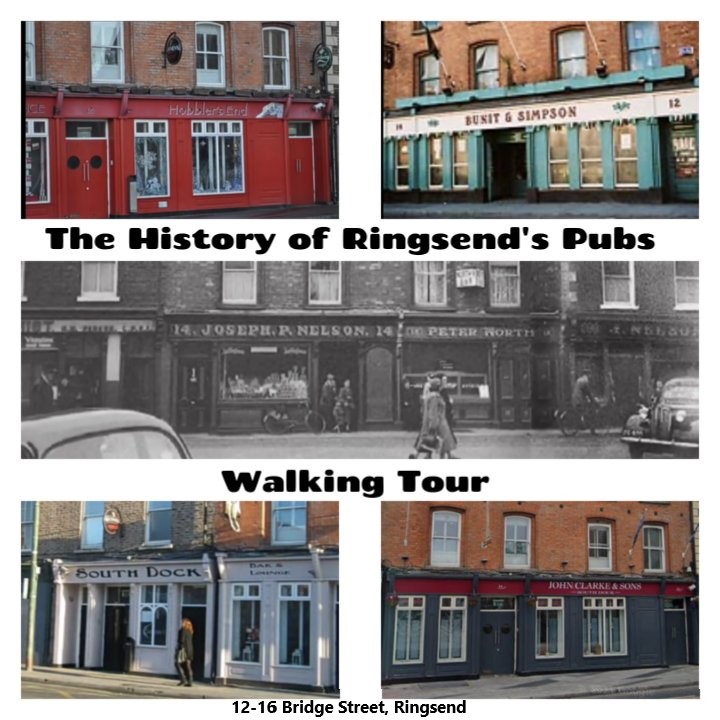
The Pubs of Ringsend Walking Tour - Episode One 'NORTH'S'


Coming in 2022, following the successful ‘The History of Sandymount’s Pub Walking Tour’ and ‘The Pubs of Rathmines Tour’, we will be bringing you ‘The Pubs of Ringsend Heritage Walking Tour’. To whet your appetite for some of the stories and tales you will hear, we will bring you over the coming weeks some of the histories of the pubs no longer open. Today we will be starting with North’s public house, in coming weeks we’ll bring you the histories of The Sign of the Highlanders, The Old England Tavern and the Hobbler’s End.


Now just a memory, but for many of an older generation in Ringsend and Irishtown, Peter North’s pub on Bridge Street in Ringsend brings back happy memories. Alas long gone but if you walk through the lounge door of John Clarke’s public house today you will have walked the route of many of North’s customers.


Peter North was a popular publican who received extensive coverage in Irish newspapers in October 1967. Peter was celebrating his hundred birthday and was described in the Irish Press as ‘probably the oldest publican in the country’. While still living above the pub, he had retired from serving pints to the locals just three years earlier as his health began to fail.


He had been born on Upper Baggot Street and served his first pint, aged sixteen, in the pub that had been opened by his father Morgan North in Ringsend. A lively sportsman, Peter, along with his brothers Francis and Bartle, played for the Isles of the Sea GAA hurling club and they won the Dublin County Championship in 1890. Peter later recalled,

‘it was some sight with 42[1] players on the field. There used to be some awful scrimmages.’

Source: The Irish Newspaper Archives

His brother Bartle was the first superintendent of the electricity generating station at the Pigeon House when it opened in 1904[2]. His son Bartle junior became a popular bookie in Ringsend with a shop on Fitzwilliam Street. Morgan North’s public house was located on the corner of Fitzwilliam Street and Thomas Street as it was known then, now known as Irishtown Road. The newspapers reported that in 1910 Peter North of 16 Fitzwilliam Street was fined by the courts for allowing children on his premises despite the fact that their mother was with them.

Morgan North pictured at the door of his pub on Fitzwilliam Street pictured in 1910
Source : Brian Siggins through his son Gerard

Today that former North public house is home to the National Council of the Blind shop. Morgan’s only daughter Mary Catherine married Valentine Nelson, the son of another Ringsend publican Joseph Nelson. The Nelson’s also ran a butcher shop on Bridge Street. In the early twentieth century, following a Pembroke Estate decision to renovate many of the properties on the part of Fitzwilliam Street that connected with Cambridge Avenue, by 1916 the North’s had moved their public house to a building next door to the Nelson’s on Bridge Street. Peter often fell foul of the licensing laws and was raided and fined on a number of occasion for serving outside permitted hours including on Good Friday 1940 after which he was fined £2 and had his license endorsed. The following June he was raided again for serving afterhours with thirteen customers on his premises. He was fined twenty shillings and was lucky not to lose his license.

Source: Google Maps

Source : National Archives of Ireland

The pub on the Fitzwilliam Street had seen previous owners Michael Holden in the 1830’s and Edward Smith in the 1850’s before the North’s arrival. Following Morgan North’s premature death at the age of just forty five, his pub’s license was operated by Anne Lowe who seemingly employed the young Peter North as a barman until he became of age to run the pub himself.

Source: Brian Siggins

Having celebrated his centenary in October 1967, just three months later in December the popular local Ringsend publican passed away peacefully and enjoyed one of the biggest funerals seen in the south Dublin suburb. When both Nelson’s[3] pub and North’s pub were sold they were joined into one pub with a bar and lounge owned by the popular Dublin publican family, the Dwyer’s.  Today the pub is occupied by John Clarke and family who had traded for many decades successful just up the road in Irishtown.

Peter North's pub receiving a delivery of beer.


[1] 21 per side was replaced by the current 15 a side

[2] Died September 1936

[3] Sold 1968


Thursday, May 25, 2017

1917 Another Potato Famine

A year after the Easter Rising the preoccupation of British newspapers with the Irish question wasn’t the reaction to the rebel executions, the rise of Sinn Fein or the massive amount of arms still in circulation on the island but headlines blazed about the humble potato.

The British were relying on food crops grown within the British Isles as German submarines were having an affect on imported goods and ships were being used for military purposes rather than food transport. The potato harvest in both Ireland and Scotland had been particularly poor in 1916 and the word ‘famine’ was again circulating. The yield in Ireland in 1916 was a quarter of a millions tons less than a year earlier and exporting from Ireland had been interrupted by the events of Easter week. Towards the end of 1916 the British Government prohibited the export of potatoes from Ireland to Britain leading to major shortages in Britain.
The Belfast News wrote,
“From Clare to Donegal and Dublin to Sligo thoughtful men are asking ‘what will happen if the people’s food is sold for export?’ there is only one answer –famine”

The Donegal Vindicator added
“The crisis has found Ireland as unprepared as the war found Great Britain. The potato famine is upon us and so are the exporters. The farmer who sells his potatoes for export today must be restrained by his more sensible neighbours. There is a food crisis.”

By early 1917, the wholesale cost of the spud had mushroomed. A ‘CWT’ (8 stone bag) of potatoes that cost between four and eight schillings in 1916, a year later was costing between eleven and fourteen schillings. Some Irish exporters had been accused of withholding supplies for export to take advantage of the ever increasing wholesale prices. The embargo was lifted on the Irish potato in July 1917 but not before the British Government ordered the Irish farmer to sell his crop for a maximum of £6 10s per ton or 1s per stone down from the reported £14 some farmer had been receiving.    

By March there were prosecutions in Ireland of those appearing to profiteer. Potato sellers Thomas Sheridan and Sons were fined £5 and £2 costs for selling potatoes wholesale to Mary Keating of Arklow for 11s 6d a CWT on March 9th when the maximum at the time was 10s 10d per CWT. There were many such prosecutions during the following six months across the country.

One newspaper editorial in Wales, an area that had been severely affected by the potato shortages wrote,

“Potatoes are not worth buying if they cost more than 4s a cwt. They have been as high as 8s this spring. The potato is of very little value as food. There is not more than   two per cent of nutriment in the potato. Potatoes at 8s a cwt are equivalent in price to oatmeal as 1s per lb which is absurd. We have largely become the victims of the potato habit. In the early part of the nineteenth century potatoes could be had for two or three shillings a cwt. In those times anybody could live for about a shilling a week on potatoes. The root had very little dietetic value; but it was "filling" and cheap at the price. When however the potato begins to cost the price of a genuine food, it is time- its character was exposed. If you have a. good dinner it is all very well to have a few potatoes as "extras" just as you would have a few tomatoes or Brussels sprouts but to regard the potato as an article of diet in itself is rank folly. If the potato were relegated to its proper place the consumption of that fraudulent tuber would decrease and its price would fall accordingly. People acquired the taste for the potato in an age of poverty and they go eating it quite regardless of the fact that its food value is almost nil. The extraordinary prices which potatoes reached in the spring were due to the rebellion in Ireland. They grow huge quantities of potatoes in Ireland but they are not so foolish as to eat them. The Irish labourer has long ago got over his partiality for potatoes. He lives on tea "soda-bread" and American bacon. Liverpool, Fleetwood, .Glasgow and Bristol all receive daily shiploads of potatoes from Ireland. There is never usually more than a week's supply of potatoes in hand in the big towns of England and Scotland. When the Sinn Fein flare-up took place all shipping between this country and Ireland was held up for a couple of weeks, and it was a month before things became normal. In the meantime the grocers in this country were getting desperate for potatoes. Travellers from Manchester and Edinburgh were scouring the wilds of Wales offering any prices for a few sacks of potatoes. The only cure for the high price of potatoes is for people to use less of them. Those who eat meat can do with less potatoes. Puddings are cheaper than potatoes just now. Those who don't use meat should not use potatoes at all. As a food they are useless; their proper function is to serve as an adjunct to meat. Our fathers formed dietetic habits when certain articles of food were cheap. When circumstances alter the habits should alter. The only point in favour of the potato is its cheapness. Once it ceased to be cheap, it ought to be discarded.”

In parts of England especially Lincolnshire,a good potato growing county, there was a different kind of Irish problem when it came to harvesting the potato crop. In 1917 the ‘Irish Need Not Apply’ signs went up at farms, pubs and shops. The local community turned on Irish labourers who would travel across the Irish Sea for seasonal work as local Englishmen serving in the British Army who were conscripted and had been sent to Ireland during and after the Easter Rising were paid one schilling per week but the Irish who had replaced them in the fields and were exempt from conscription in what locals saw as appeasement were being paid between five and seven schillings a week to replace them.


By the end of 1917, the price had stabilised and the threat of famine in both Ireland and Britain had receded but by the end of that year consumers had discovered alternatives to the potato like swede, turnip and parsnip and as the First World War came to a conclusion the potato crisis had abated.  

Saturday, April 15, 2017

Sandymount International Airport

On a warm summer afternoon a glance skywards as you lay on Sandymount beach a passenger jet blazes a trail across the sky but in the 1930’s plans were developed for a new International airport for Dublin to be located in Sandymount on the land now occupied by Sean Moore Park and the Irish Glass Bottle site. In the early days of the Free State, international flights left from Kildonan Aerodrome in Finglas but when Aer Lingus was launched in 1936, its first flights departed from Baldonnel. The decision was eventually made that a former RAF airfield at Collinstown would be developed into what is today Dublin Airport.

In 1935 following a Dublin Ports and Docks Board visit to Sydenham Airport (now George Best Airport) in Belfast which was built on reclaimed land, the plan was proposed to build a walled enclosure to reclaim land from the sea from Newgrove Avenue to the Pigeon House and into Irishtown. The report stated that the 15,000 feet wall would enclose 1,400 acres and with reclamation would cost £1.5 million with another £1m needed to build a runway and infrastructure. Its proximity to the tram line into the city centre and the nearby railway station at Sandymount Avenue were cited as important criteria.

In 1936, Mr. J Johnson Mullan of Sandymount Castle in a letter to the Irish Press advocated the plan as an excellent idea and marvelled at the possibility of seeing the lights of an international airport on the foreshore. He recommended that the Dublin Corporation and the DPDB immediately begin work its implementation. The first flight into the completed alternative Dublin Airport was in January 1940 after a three year building project

An aerodrome of sorts in Sandymount was operational during the visit of the aircraft carrier USS John F Kennedy in 1996. With the massive vessel anchored in Dublin Bay, Ciaran Haughey’s Celtic Helicopters operated a sightseeing service for the duration of the visit from what is today the park area nearest the beach on Strand Road. Two helicopters were deployed and hundreds availed of the opportunity to have a helicopter jaunt out over Dublin Bay spotting both the massive ship and most probably their own home from the air. 

At one stage proposals were placed before Dublin County Council for the creation of a heliport on the Poolbeg Extension but were quickly shelved.

In 1998 the then Councillor and later An Tainiste John Gormley complained at a Dublin Corporation meeting that a deal had been struck between the Corporation and Celtic Helicopters to allow Sean Moore Park as a base for commercial flights. The Corporation did admit there was an agreement but that it was only for occasional flights and they did not reveal the financial arrangements that had been made.


Tuesday, April 11, 2017

Sandymount Green Through History

The story of Sandymount begins with an area known as Scallet Hill in the middle ages. The area then was a swampy marsh land surrounded by the Irish Sea on one side and the unbridled River Dodder on the other side. In the late 1700’s Lord Fitzwilliam built an embankment to hold back the sea from Merrion to Sandymount. The course of the Dodder was regulated and the land dried enough to begin building houses. The area was renamed Brickfield and from the 1820’s onwards the development of Sandymount continued apace and is still evolving even today.

The centre piece of Sandymount is the Green. A triangle of recreational green space that was opened to the public in 1900 after Lord Pembroke donated the waste ground hoping that a nice park would allow him to charge higher rents for the many properties he owned in the area. In 1904 an ornate water fountain was erected as a centre piece but it has long since disappeared although the drinking fonts that were also put in can still be seen today.

The statue sculpted by Arthur Power in the Green is that of the great poet William Butler Yeats. His family at one time lived in the Castle at one end of the Green. Yeats himself was born on June 13th 1865 on Sandymount Avenue. Yeats would be romantically involved with Maud Gonne and won a Nobel Prize for Literature in 1923. He passed away in 1939 in Paris France but it was not until September 1948 before his body was repatriated to Sligo and upon his headstone are the lines,
                        Cast a Cold Eye
                        On Life, on Death,
                        Horseman pass by.

The first recorded licensed premises on the Green was in 1834 and a hotel and tavern owned by Anne Tunstall. In 1850 Martin D’Arcy operated a public house at Number 5 Sandymount Green also known as ‘Tippers’.

The advertisement for the sale of White’s notes that Number One had the lease as a pub granted to it on September 29th 1849.
  
In 1870 there were three public houses on the Green. Apart from D’Arcy’s there was Fox and Hanrahan’s and Peter Kenny’s. Michael Hanrahan was the first man to have a pub located at Number One Sandymount Green and named it the Sandymount Tavern. With his partner Fox they also had a pub located at 72 Upper Dorset Street on Dublin’s North side.

In 1875 Charles McCabe arrived in the Village with his brother Richard who opened a grocer’s shop next door which was numbered as 1a.

In 1880 Daniel Burke became the publican at Number One Sandymount Green. This was one of four pubs he owned in the city. He was also operating on Baggot Street, 2-3 South King Street near where the Gaeity Theatre stands today and at Number 4 Ballsbridge near where Crowe’s Public House now stands.

Much of Burke’s success was probably due to the arrival of the tram system that connected the village with the city centre. Sandymount became a popular tourist attraction with it beaches, open spaces and off course fine public houses.

In the early 1870’s tram tracks were laid from the city centre along Mount Street and through Bath Avenue and onto Sandymount village for a horse drawn tram service that connected the Martello Tower on the Strand Road with Nelson’s Pillar in O’Connell Street. The service began on October 1st 1872. In 1872 the service then began at Gilford Road where horse stables and garages were built. The journey with a two horse tram would travel from the Tower via the Green, Tritonville Road and down London Bridge Road until they passed beneath the railway bridge where a stable hand would be on duty with two extra horses to pull the tram up onto Northumberland Road and then return to Bath Avenue to await the next tram.

On January 14th 1901, the horse was replaced with electricity on William Murphy’s Dublin United Tram Company route. It was one of the few routes served by a single deck tram known as a ‘bogeycar’ due to the low bridge on Bath Avenue.

In those days the routes were not numbered but name plates at the front of the tram indicated its destinations and in order to assist those many who were illiterate at the time in Dublin a green half crescent indicated that it was the tram required for any one travelling the route from Sandymount to the city centre.

The tram service ceased on the route on 31st July 1932. For many years Coras Iompair Eireann, the forerunner of Dublin Bus operated the number 52 bus, a single deck bus that became a one man operation and ran from Lakelands School to Hawkins Street. The number 52 which was then used to service University College Dublin was removed from the route in 1998


Today the Dublin Bus routes Number Two from Parnell Square to the Green and the Number Three from Whitehall to UCD through Sandymount serve as the quickest way to find your creamy pint in Ryan’s. The Number Eighteen arrives at its terminus on the Green from Palmerstown. The DART stations at Lansdowne Road and Sandymount are only minutes away.

In 1890 John Butler a young publican arrived to serve the pints to the growing and affluent suburb. John Butler was a native of Annefield County Cork and died January 18th 1890 just thirty three years old. He is buried in New Drom Cemetery, County Tipperary with a headstone erected by his sons Lawrence and Thomas. Thomas ran a pub at 18 Camden Street where Anseo is presently located. Thomas died two years after his father on March 4th 1892 while Lawrence died March 31st 1904 aged seventy three. Following the death of Thomas the pub was put up for sale.


In 1893 Patrick S Fleming arrived. Fleming saw in the new century and perhaps he was standing at his door when Leopold Bloom passed through Sandymount on June 16th 1904. Bloom’s exploits were magically recounted in James Joyce’s work ‘Ulysess’


Then there was the exciting events surrounding the Easter Rising in 1916. No doubt many of the Irish Volunteers frequented his premises as they used the Sandymount Castle grounds as a training area under their local commander John McBride.

The 1911 Census lists the occupants of Number One Sandymount Green as

Patrick Fleming, 50, Roman Catholic born in Co Limerick and married for 17 years
Kate Fleming, 48, Wife Roman Catholic born in Co Tipperary mother of 4 Children
Mary Fleming, 15 Daughter Roman Catholic born in Co Dublin
Thomas Fleming, 14 Son Roman Catholic born in Co Dublin                          
Francis Fleming, 13 Son Roman Catholic born in Co Dublin
Florence Fleming, 11 Daughter Roman Catholic born in Co Dublin
Patrick McEvoy, 28 Boarder Roman Catholic born in Co Dublin Barman
Edward O'Grady, 26 Boarder Roman Catholic born in Queen's County Barman
John Hughes, 24 Boarder Roman Catholic born Co Roscommon Barman
James Cullen, 23 Boarder Roman Catholic born in Co Kildare Barman
James Hennessy, 18 Boarder Roman Catholic born in Co Tipperary Barman
Alfred Coffey, 18 Boarder Roman Catholic born in Co Meath Barman 
Margaret Connelly, 30 Servant Roman Catholic born in Co Wexford Domestic Servant

The Irish National Census of ten years earlier noted that Fleming’s staff were
Patrick Hedigan aged 26 born in County Limerick
Daniel O’Connell aged 26 from County Limerick
Gerald Barry aged 23 born in County Limerick
William Lawlor aged 18 from County Tipperary
Phillip Ryan aged 17 from County Tipperary

In 1920 Fleming’s friend and publican across the road Sylvester White bought the premises. White had been the landlord in what is today O’Reilly’s on Seafort Avenue and sold to the O’Reilly family arrived in 1922. In the Poor Law Elections the two men are noted as the proposer and second of George Bardon of Prospect Place. Sylvester then forty three years old was ably assisted by his older brother Denis.

In 1925 Joseph Ryan bought the pub and traded successfully through ‘The Emergency’, the Irish term for the Second World War. During the war years 1939-1945 the local air raid siren was located on the roof of the pub. Kevin Mullan remembered the night it sounded in earnest when German bombers flew over Dublin on May 31st 1941 and dropped their deadly bomb load on the North Strand killing twenty eight people and destroying over three hundred houses.

In 1958 through the estate agency Morrissey’s, the pub was sold to Mary Heelan. In 1974 the same agency sold the pub for £172,000 and renamed ‘Fagan’s’.

In 1985 it became known as The Sandymount House and attached was the Le Detour Restaurant and the offices of Diamond Windows Limited. The pub was bought by well known Tipperary born Dublin publican Gus Ryan. In 2008 Gus retired from the business and his son Vincent and his wife Elizabeth became the publicans.

Today Ryan’s on Sandymount Green is a vibrant pub at the heart of the village. 

The Wren…….
If you have never heard of the ‘wren boys’ on St Stephen’s Day in Sandymount, where have you been?
The Wran - The Wran - the king of all birds
On Saint Stephen's Day was caught in the furze
Although he is little his family is great
Come out your honour and give us a trate

Hurrah me boys hurrah

The origins of the Wren Day are based on pagan legend and its true beginnings lost in the fog of history. In modern times, the Wren Boys descend on Sandymount Green on St Stephen’s morning to celebrate and enjoy the festive season. The Guinness Gig Rig, a mobile stage, is on hand to let hundred of performers play and dance to Irish traditional tunes and maybe to give the few bars of a song.

The tradition is marked with those involved dressing up in masks and straw hats and as colourful pieces of clothing as you have in your wardrobe. If you are in the crowd you are known as a mummur. In rural parts of Ireland, the children dress up and go from pub to pub entertaining the customers with music and dance and earning some pocket money along the way. Once the festivities on stage in Sandymount reach there conclusion perhaps on a cold December morn its time to repair to the warm comfort of Ryan’s for a few hot whiskeys and the sharing of the Christmas spirit.


The Good, The Bad and The …….