BOOK TODAY

BOOK TODAY
AWARD WINNING TOUR IN DUBLIN

EASTER RISING COACH TOUR

EASTER RISING COACH TOUR

ATTENTION COACH and TOUR OPERATORS

ATTENTION COACH and TOUR OPERATORS
Our friendly and excellent guides are available as Step On Guides for any visiting tour or coach operators who may like a unique, entertaining and educational tour of Irish History and the events of Easter Week 1916.
Showing posts with label 1916 rebellion. Show all posts

Sunday, March 14, 2021

Pictures of the Actual Equipment & Aerials used by the 1916 Rebels to Broadcast to the World


In the early 1990’s I read Maurice Gorham’s book ’40 Years of Irish Radio’ and after a couple of pages I came across the startling discovery for me that the rebels during the 1916 Easter Rising ‘broadcast to the world’. I thought,

‘why are we not celebrating this unique historical fact more?’

I began to research the subject slowly to find out if it was, as some history books put it ‘a happenchance event’ or that it could not be really described as a radio station as no one had heard these broadcasts. In an old Jackdaw publication from the 1970’s, that my parents had bought me as a birthday present’ was many facsimiles of documents relating to the Rising and one of those was a signed order from James Connolly ‘to protect our wireless station’.

For the next twenty-five years when work and family time allowed me, I continued to research the subject and the picture emerged of a truly historical event, that Ireland became the first nation in the world to be declared by radio. The culmination of that research was my 2016 book ‘Rebel Radio’ published by Kilmainham Tales Teo. It sold extremely well, and it led to the commemoration of the rebel broadcasts erected at the site of station, now the Grand Central Bar on the corner of O’Connell Street and Middle Abbey Street.

Since the publication more information has come to light of both the scope and success of the station and I want to share some of it here with more appearing in the next edition of the book due out in 2022.

First are pictures of the actual aerials and equipment that was used by rebels in 1916 and taken in the rooms that the rebels seized in April 1916. These pictures were taken when the Irish School of Wireless Telegraphy originally opened in March 1913 as a subsidiary of the Northern Wireless School, that was based at 47 Market Street, Manchester. Photographed sitting at the table in front of the receiver in the station is the School’s chief instructor when it opened A. P. Corcoran, a former Naval Marconi wireless officer. We know it is the equipment used by the rebels as the School was closed in 1914 by the British authorities under the Defense of the Realm Act at the beginning of the First World War.

AP Corcoran behind the desk in the Wireless School on the top floor of Reis's Chambers
The aerials on the roof of Reis's Chambers. Taken down after the enforced closure at the beginning of the First World War. They were left on the roof and partially re-erected by the rebels including John Blimey O'Connor and Fergus O'Kelly to allow the rebel broadcasts. 


 In the aftermath of the Rising and Reis’s Chambers completely destroyed where the rebels had broadcast from, the Marconi Company who had leased the equipment to station owner Phillip Keston Turner (later to be one half of the duo who invented Hi Fi), claimed for damages for the loss of the equipment used to run the Wireless School.


For any radio stations listeners as a valuable commodity. In the book we already discovered that the rebel station was heard by the wireless operator on board HMS Adventure, the journalist Sidney Cave and an amateur wireless operator in Wales. This letter that appeared in the Irish Times in March 1961 written by J G Reid, reveals that the station’s broadcasts were also picked up by the wireless operators at the Naval wireless station in Skerries.

(c) 1916 Easter Rising Coach Tour 2021


Sunday, November 8, 2020


Purchase your signed copy of this important historical account of the role of Pubs, Publicans and their staff in the fight for Irish Independence. 

Pay via secure paypal by contacting


thirstforfreedom@mail.com


with your contact details. 

Wednesday, September 25, 2019

Ireland's Biggest Funerals


Ireland’s funeral traditions have been well documented and in modern times some of Ireland’s most famous citizens have been honoured with very large funerals. Today the ceremony and reverence displayed at a state funeral is often conveyed on television and with access to instant media, the large funerals of the latter part of the 19th century and early 20th century have become less common. This is a list of thirty of the largest funerals ever seen in Ireland.

To attract an attendance of over 15,000 at your funeral in 1729 was a remarkable achieved both to your status and the efforts of those to attend in an era when transport options were limited. This though is the esteem to which William Connolly, known as The Speaker Connolly was held when he died in November 1729. Born in Ballyshannon the son of an innkeeper, Connolly rose to become the Speaker of the Irish House of Commons and a popular politician. Once in charge of the Revenue Commissioners though his position as the Speaker he was the de facto PM in Ireland. His legacy was to build the impressive Castletown House as the family residence which can still be seen today.

In the mid-19th century with a growing sense of Irish nationalism in the face of the worst famine to hit the country, the funeral of the nationalist Daniel O’Connell was bound to draw a large crowd. O’Connell, after whom the main thoroughfare of our capital is named, died in August 1847 in Genoa, Italy and his body returned to Ireland for burial. According to the London Times 100,000 lined the streets of the city to bid farewell to the native of County Kerry.

In March 1861, the Evening Post reported that on a desperately wet day, over 20,000 people attended the funeral of Captain John Boyd O’Neill. O’Neill was Captain of HMS Ajax and had lost his life heroically saving others as a storm raged in the Irish Sea. He was buried in St. Patrick’s Catederal.

In November 1861, Fermanagh born Young Irelander Terence Bellew McManus died in San Francisco and his body transported to Ireland for burial. He had taken part in the 1848 Rebellion and having been convicted was sent to Van Diemen’s land. He escaped from Australia after three years and made his way to the United States. His funeral to Glasnevin cemetery according to the ‘The Nation’ newspaper was watched by over a quarter of a million people on the streets of Dublin. Of that total 50,000 marched behind the coffin as it made its way through the city.

When the Most Reverend Daniel O’Connor, the Bishop of Saldes died at the Augustinian Friary at John’s Lane Church in July 1867, fifty thousand Dubliners lined the cortege route from Thomas Street to Glasnevin Cemetery. Born in 1786, he joined the priesthood in 1810, he spent many years on the missions in India. He returned to Ireland suffering from ill health caused by the extreme tropical conditions to continue as a popular bishop in Dublin for over twenty years. These years included the worst of the famine years and the political upheaval caused by the growing rebellious movement across Ireland against British rule. He passed at the age of 81.

In May 1876, The Nation newspaper reported that a crowd in excess of 20,000 ‘sombre souls’ lined the funeral route for Joseph P Ronayne in his native Cork City. Born in 1822 the son of a Cork glass maker he made his name as a civil engineer especially through the expansion of the railways in Munster. He was elected as a Cork member of Parliament for the Home Rule League in a 1872 bye election, retaining the seat in the 1874 General Election. He died in Queenstown and in an obituary he was described as being ‘endeared by all, by a noble generosity, a genuine spirit of self-abnegation, a modesty that could conseal neither his remarkable powers not the brillancy of his wit. A gracious manner, open handed charity and a kindly heart.’

In October 1891, Dublin would witness one of the biggest funerals ever seen in the city, even to this day. Even at the relatively young age of 45 at his death, Charles Stewart Parnell left a lasting impression on his nation and a legacy that helped Ireland achieve independence. Born in Avondale, Co. Wicklow he was elected to the British House of Commons in April 1875 as a nationalist MP. His Home Rule party, The Irish Parliamentary Party struggled for the morale high ground with revolutionary nationalists like the IRB but his party in 1885 held the balance of power in Westminster and his support of the Liberal Government was conditional on Home Rule being adopted for Ireland. At the height of his success, a personal scandal when it was revealed that he was having a longtime affair with a married woman Kitty O’Shea and had fathered a number of his children irrevocably damaged his reputation and career. When he died in 1891 after a gruelling election campaign when he was already in ill health took his life, nearly a quarter of a million people lined the streets of cold snowy Dublin to bid farewell to the Irish patriot and statesman.

In a new century in March 1903, one of the old guard of Irish nationalism Charles Gavan Duffy died in France. His body was returned to Ireland where the Freeman’s Journal reported in excess of 20,000 on the streets of the capital to watch his coffin being transported from the docks to the Pro Cathedral and onwards to Glasnevin Cemetery.

One of the biggest funerals ever witnessed as an orchestrated piece of nationalist theatre. When the elderly leader of the IRB, Jerimiah O’Donovan Rossa died in New York, his body was transported back to Ireland in July 1915 for a stage managed funeral to Glasnevin which will historically be remembered for Patrick Pearse’s graveside oration which included the famous quotation, ‘they have left us our Fenian dead, Ireland unfree shall never be at peace’. The rallying cry was the opening verbal shots of the 1916 Easter Rising. Twenty thousand marched behind the hearse from the Pro-Cathedral on Marlborough Street to Glasnevin with the streets lined by over 150,000 according to Irish Independent and the Freeman’s Journal.

As the green fields of France turned crimson red with blood, a German U boat off the coast of County Cork caught the ocean liner The Lusitania in its torpedo crosshairs. On May 5th 1915, as she reached the conclusion of her cross Atlantic crossing from New York to Liverpool with 1,962 guests and crew on board she was sunk by German torpedoes. 1,198 people lost their lives in the icy waters off the Cork Coast. Bodies that were recovered were taken to Queenstown (Cobh) where a mass grave was prepared long before a DNA service could identify those who had no personal belongings to repatriate them to their families. According to British Pathe over 10,000 lined the route as one hundred and forty-eight unidentified victims were taken to a small cemetery the crowds made up of locals and military personal based in Cork.

The most deaths the following year was those executed in the aftermath of the Rising but they were not accorded a normal burial instead buried by the British in then unmarked graves. In September 1917 more than forty thousand lined Dublin streets in defiance of the British authorities to witness the funeral of Thomas Ashe who had died following complications in Mountjoy Prison when he was force fed by the prison authorities after being on hunger strike. The British in their clumsy attempts not to create another martyr for Irish nationalism offered the perfect patriot for a huge funeral on the streets of battle damaged Dublin.

Outside the capital, in Cork in November 1920 the Mayor of Ireland’s second largest city Terence McSwiney died on Hunger Strike at Brixton prison in England after 74 days on strike. Future Vietnamese leader Ho Chi Minh who was in London at the time of McSwiney’s death remarked, ‘a nation that has such citizens will never surrender’.  After the murder of his mayoral predecessor Thomas McCurtain on March 20th 1920, McSwiney was elected mayor. He was arrested by the British military forces on August 12th and sentenced to two years in prison following a court martial charged with having seditious material. Thirty thousand filed passed his coffin at St. George’s Catederal in London. Fearing a massive Republican funeral in Dublin, the British forced his family to take his body directly to Cork. Despite heavy and at times brutal security arrangements put in place by the British, over 15,000 attended the funeral in Cork where McSwiney was laid to rest in St. Finbar’s Cemetery.

The politician who would deliver the graveside oration for Terence McSwiney would be the recipient of the next big funeral in Dublin in August 1922, when Arthur Griffith died. Griffith had headed the delegation that attended Downing Street for the Treaty negotiations at the end of the War of Independence. He worked tirelessly and even though ill continued a heavy workload leading to his collapse and death on a Dublin street on August 12th 1922. According to various newspapers reports of the day over 100,000 people lined the streets of Dublin from the Pro Catederal to Glasnevin cemetery four days later. One of the most high profile mourners was Michael Collins who would replace Griffith’s as the de facto head of state.

Collins himself morbidly would be the next big funeral in Dublin. Ten days after Griffith’s death, while touring his native County Cork, Michael Collins’s motorcade was ambushed near Beal na Blath outside Macroom. In the midst of a bloody Civil War, the Free State forces transported Collins’s body via ship from Cork to Dublin where his body lay in state at City Hall. The funeral mass was celebrated by the Archbishop of Dublin Rev. Byrne along with 300 priests. A gun carraige drawn by six black horses carried the coffin and fourteen further cars were required for the wreaths. To allow as many as possible to witness the occasion, the cortege left the Pro Cathederal and headed down Gardiner Street, over Butt Bridge onto Great Brunswick Street (now Pearse Street), around Merrion Square, onto St Stephens Green, down Grafton Street, through O’Connell Street and onto Glasnevin via Dorset Street taking over four hours to pass any one point on the route. A half a million people paid their respects to the fallen leader followed by a graveside oration delivered by General Richard Mulcahy before internment.
 In April 1932, one of the largest funerals for a woman took place when the mother of the executed 1916 leader Patrick Pearse, Margaret passed away. Having lost two sons to the executioner’s bullets in 1916, Patrick and William, Margaret continued to be a political activist for the rest of her life. In 1921 she was elected as a Sinn Fein MP but having taken the anti-treaty side during the subsequent debates in Dail Eireann she left with DeValera. She helped DeValera found Fianna Fail and also strived to keep open her son’s school St. Enda’s in Rathfarnham raising thousands to keep it going.  Her funeral, soon after Fianna Fail and DeValera had taken power for the first time was a propaganda coup for the new Government. An estimated 40,000 filed passed her coffin laying in state in City Hall and over 100,000 lined the four mile route from Westland Row to Glasnevin where DeValera delivered the graveside oration.

One of the saddest funerals in Dublin was that of three firemen Thomas Nugent, Peter McArdle and Robert Malone of Tara Street station who were killed as they fought a fire on Pearse Street in October 1936. Led by Eamon DeValera and members of the Government, along with the families of the fallen firefighters and colleagues from Dublin, Ireland and further afield, the cortege travelled from the con-celebrated Mass in Westland Row to Glasnevin watched by what the Irish Press estimated as 100,000 people but other sources put the total nearer 40,000, still an impressive turn out in tribute. A volley of shot was fired over the graves by colleagues of Robert Malone, who had served alongside DeValera in Boland’s Mill during the Easter Rising.

In November 1960, Ireland was taking its place amongst the nations of the world and lending its weight to UN peacekeeping missions around the world but events in the Congo would according to the Irish Independent bring 300,000 Irish citizens onto the streets of Dublin to pay tribute to 9 Irish soldiers murdered at the Niemba ambush in the Congo. Those who died were Kevin Gleeson and Michael McGuinn from Carlow, Hugh Gaynor, Peter Kelly, Liam Dougan, Matthew Farrell, Thomas Fennell, Anthony Browne and Gerard Killeen all from Dublin.

In the days before the Easter Rising, former British diplomat Roger Casement was arrested for treason for his contacts with the Germans as he attempted to land arms off the coast of Kerry. He was secretly transported to London where he was tried and executed at Penteville Prison. In accordance with most execution he was buried within the prison walls in an unmarked grave but as relations between the two islands thawed, Roger Casement’s body was returned to Ireland for burial at Glasnevin cemetery in March 1965. According to the Evening Herald 30,000 lined the streets of the capital as the cortege passed the GPO on its way to the northside burial grounds.

Dublin born Sean T. O’Kelly became Ireland’s second President in June 1945 and served two terms. A veteran of the Easter Rising and the War of Independence, he served in various roles including Sinn Fein’s envoy to the US after the Civil War and in various Fianna Fail cabinets after 1932. He passed away in November 1966 with the Irish Press reporting 30,000 lining the streets of the capital to bid farewell to the former President.

As 1969 arrived the troubles in Northern Ireland intensified and in September 1971 the death of a fourteen year schoolgirl shot dead in Derry brought 10,000 out onto the streets of the Maiden city for her funeral. Annette McGavigan was caught in crossfire between an IRA unit and British soldiers near her home in the Bogside. She became the 100th civilian to be killed since the start of the troubles and her memory remembered in the ‘Death of Innocence’ mural in the Bogside where she is depicted in her green school uniform. Civil rights leaders including Ivan Cooper and John Hume attended the large funeral.

One of the survivors of the Easter Rising and a man at the heart of Irish history for over a quarter of a century Eamonn DeValera died aged 92 years in August 1975. His wife of 65 years passing away earlier the same year. Having cheated the executioner bullet after the Rising, he would go on to lead the anti-treaty forces during the Civil War and in its aftermath found a new party Fianna Fail who came to power in 1932. He led the Government until 1959 when he became President of Ireland serving two terms in Aras An Uachtarain. Over the first weekend of September, his casket lay in State at St Patrick’s Hall in Dublin Castle and according to the Irish Examiner more than 100,000 filed through the great hall to pay their respects. More than 100,000 lined the streets of Dublin as the cortege travelled up O’Connell Street passed the GPO and onto Glasnevin for burial.

One of the few sportsmen to make the list is the great Cork hurler Christy Ring. When he died in March 1979 he was a legend in the GAA. Just 58 years old when he suffered a massive heart attack as he walked along the streets of his beloved city, Christy’s prowess as a centre forward earned him nine Munster titles, eight All Ireland titles and eighteen railway cups hurling with Munster. In 2000 he was named as the right wing forward on the team of the millennium. The former Taoiseach and fellow Cork native Jack Lynch said upon his passing
‘As long as young men will match their hurling skills against each other on Ireland's green fields, as long as young boys swing their camáns for the sheer thrill of the feel and the tingle in their fingers of the impact of ash on leather, as long as hurling is played the story of Christy Ring will be told. And that will be forever.’

Two years later saw one of the biggest funerals ever seen on the island in May 1981. Following sixty six days on hunger strike at the Maze prison also known as the H-Blocks, twenty seven year old Bobby Sands died. During his strike and incasaration he was elected as a British member of parliament for Fermanagh and South Tyrone. Sands became the first of ten Reublican prisoners to die during that period as the Brotosh Government refused to give into the demands of the prisoners who were seeking political status rather than. Over 150,000 people lined the streets of Belfast as Sands was buried in the Republican plot at Milltown Cemetery.

In June 1996, as IRA subversives attempted to rob a cash in transit van in Adare, Co Limerick, the gang opened fire on two Garda special branch detectives who were protecting the delivery. Garda Jerry McCabe was shot dead, His funeral was attempted by in excess of 40,000 shocked locals lined the funeral route through Limerick City with mourners led by his wife Anne. Four IRA men were subsequently convicted of manslaughter of the Garda.

The sudden passing of motor cycling superstar Joey Dunlop following an accident in Estonia drew in excess of 50,000 to the small town of Ballymoney Co. Antrim. It took the hearse bearing the sports stars body who had made the famous Isle of Man TT races  over an hour to travel the single mile from his family home to the local church for the funeral service.

Diarmuid Fawsitt, An Unusual Diplomat


Diarmuid Fawsitt, An Unusual Diplomat

In September 1919[1], with the War of Independence raging in the Irish countryside, across the Atlantic the fledgling State had appointed Jerimiah (Diarmuid) L. Fawsitt as Consul General in New York and led the first official Irish Trade Commission. The United States was vital as pressure on the Wilson administration would be vital in achieving legitimacy and the diaspora on the far side of the Atlantic would be both a source of fundraising for the campaign against the British and an important trading partner when Independence was won.  The Consulate opened offices located at Suite 404 in 280 Broadway, Manhattan and Fawsitt was the first appointee of the new Dail Eireann.  

He was born in Bandon, Co. Cork and made his name as the Secretary of the Cork Industrial Development Association. He forcefully encouraged overseas business to both invest in Ireland and to trade with Ireland. One of his great successes was encouraging Henry Ford to build his first car factory outside the United States in Cork. When DeValera arrived in the U.S. in June 1919, he introduced Ford to DeValera. As a fellow Corkonian he also enjoyed a very close relationship with Michael Collins and was pro-treaty when the peace arrived.

The son of a Cork builder, he joined the IRB in February 1904. In 1911, he married Tipperary born Kathleen Kenny and the couple see eleven children born up to the youngest Ethna in 1931. Fawsitt became President of the Executive of the Volunteers in Cork[2] which he helped found in 1913. He was involved with Sir Roger Casement and helped to fund the arms shipment from Germany in advance of the Easter Rising. In 1915 he was ordered by the British authorities to leave Cork and he travelled across the Atlantic and went on a lecture tour laying the ground work for his appointment as the first Irish Consul in New York in 1919.

Even before his departure for the United States, in January 1919 he received a polite rebuff from the White House after inviting President Woodrow Wilson to visit Cork. He battled hard to improve direct trade between Ireland and the United States and throughout 1919 battled to get a direct shipping route from the East Coast of America to Cork striking a deal with the Moore and McCormack Line. Much of the then trade traveled by ship across the Atlantic to Liverpool and Southampton before being then sent onwards to Ireland. While serving in New York he had several run ins with fellow Irish-American James O’Mara, who complained to Dublin about the extravagance of the Irish consulate in NY and at one stage refused to pay a $32,000 maintenance bill eventually the dispute forced DeValera himself to step in and resolve the issue. In an era where rumour and gossip often had an impact on views, Fawsitt was rumoured at one time to be involved on the orders of DeValera to kill James Larkin while he was in the US. Larkin was seen as an agitator and troublemaker and was now overly welcomed back to Ireland in the early days of the new State.

In August 1920 left the job and returned to Ireland He was officially replaced in October 1921 by Belfast man Joseph Connolly. In 1920 he traveled across the US to San Francisco to take part in the welcoming committee for the controversial Australian Archbishop Daniel Mannix and he wrote a moving obituary in the US newspaper for his former schoolmate the late Thomas McCurtain, the Cork Lord Mayor who had died on hunger strike. Fawsitt was an economic advisor at the Anglo-Irish Treaty negotiations in 1922 and subsequently became an assistant secretary of the Department of Industry and Commerce (1922-23), and in this position played a role in developing the scheme for compensation and reconstruction following the burning of Cork in December 1920

Fawsitt went on to become a leading Judge and he died April 1967 and is buried in Sutton, Dublin along with his wife who pre-deceased him. Their grandson Duncan Stewart is a well-known television personality, while their daughters Sheila, Kathleen and Marie had roles in the 1937 film Some Say Chance.


[1] http://www.bureauofmilitaryhistory.ie/reels/bmh/BMH.WS1728.pdf#page=10
[2] http://www.bureauofmilitaryhistory.ie/reels/bmh/BMH.WS0939.pdf#page=119

Tuesday, March 5, 2019

The Books from the 1916 Tour

Rebel Radio
The story of the broadcasts from the rebels of 1916 when Ireland became the first nation in the world to be declared by radio.

http://kilmainhamtales.ie/14---rebel-radio.php

The Battle for Facts, American Journalists during the 1916 Easter Rising


https://www.amazon.co.uk/1916-Easter-Rising-American-Press/dp/1520722346

Facts of the Rising you never knew.


COMING SOON
The Thirst For Freedom


Monday, November 20, 2017

Ireland To Get Extra Seven Bank Holidays

For a number of years there has been a discussion about creating a Republic Day to celebrate our independence as a sovereign nation. We do celebrate St Patrick’s Day but that is a celebration of our tribe not our nation. But if we create a Republic Day as an extra Bank or Public Holiday when should be celebrate it?

The creation of an extra bank holiday has its own issues. There is a cost to the employer with Bank Holiday rates. There is a cost to the Government as productivity is reduced and costs rise. There is a threat to the economy as it recovers from years of austerity. A Bank Holiday to celebrate our nationhood should benefit all our citizens’ not just Civil Servants with an extra paid day’s leave or public service workers with increased bonus payments. Children get a day off school and college but parents who work may have to pay for extra childcare. Hospitality workers work extra hours including extended opening hours in the bar industry on the Sunday eve of a bank holiday. Old age pensioners who have worked all their lives receive no benefit from a bank holiday and feel less inclusive. A Republic Day should be a day off for everyone and the State should provide the financial bonus to all our citizens young and old. Emergency services and armed Forces personnel should be paid an extra bonus or be provided time in lieu.

So perhaps to the most important question. When? There are a number of dates.

April 24th – The day that the Easter Rising begun. This will often create an extra Bank Holiday in the month of April as Easter falls primarily in April. The next question is should it always be April 24th even if that falls on a Saturday. Traditionally Bank Holidays are on a Monday or maybe we could choose

April 18th – The date in 1949 when the Republic of Ireland Act cam into force and the nation of whom we wish to celebrate The Republic of Ireland came in being

December 6th – The date in 1922 when the Irish Free State became a legal entity and we achieved our independence from Britain

January 21st – When the first Dail met in 1919, the lineage of today’s Irish parliament t and they declared independence.

August 22nd – In 1798 and a Republic of Ireland is declared by the invading French forces in Connacht and John Moore named as the Republics first president

July 23rd – The declaration of a republic as Robert Emmet’s rebellion is launched on this date was the first declaration of an Irish Republic although that referred to a 32 county Ireland not the presently constituted 26 counties.

March 5th – The 1867 proclamation of an Irish Republic has as much validity as the proclamation in 1916 and perhaps it should be recognised as a more neutral non political date to celebrate Republic Day.

Ireland to get an extra seven bank/public holidays? I wish but if no decision can be made, make them all Bank Holidays and we can have an extra week of holidays in the year.
Perhaps as a neutral alternative we could have a President's Day when we can celebrate the role of our President of the Republic of Ireland.


Sunday, November 12, 2017

Summerhill Publican Mentioned in the House of Commons


There are not many Dublin public houses who have found themselves at the heart of political debate and even fewer who have been mentioned on the floor of the House of Commons at Westminster. But in March 1871 this is exactly what happened.

Cavan born Charles Lynch was running a public house at 121 Summerhill on the corner of Summerhill and Lower Gardiner Street. In early March his brother Owen was taking over the business. Owen was already running a pub on Mabbot Street. As it required today the licence needed to be transferred from one brother to the other. On March 6th 1871 Owen had his officially opening at Summerhill. His pub was full and as was and is customary the new publican provided free beer, wine and spirits for those who were invited to the event.

Closing time in 1871 was 10 p.m. and shortly after that hour the local police arrived at the door. Police Constable Mark Byrne of C Division of the Dublin Metropolitan Police stated after that when he arrived at the door of the pub he ‘found it crammed full of people who were drinking and they were very disorderly’. Another Constable stated that many of the patrons were ‘in a drunken state and quarreling with each other’ although they were packed so tightly in that they had no space to fight. The policemen asked the Lynch’s to clear their pub but they either refused or were under the impression that they were to be given a little bit of leeway from the local inspector. Several customers who had become belligerent were arrested and taken to the police station. The aftermath of the raid was that Charles Lynch was fined one guinea while it appeared that the licence had not in fact been transferred and therefore Owen Lynch opened his pub without a licence and was illegally selling alcohol drinks. Owen was fined five guineas.

One of those arrested was local labourer thirty six year old William Keely who the police stated was arrested for his own protection as he was highly intoxicated. At 2 a.m. in the police cell he became quite ill and the decision was made to transfer him by police horse and car to the Mater Hospital but he was dead on arrival. A post mortem was performed by Doctor R W Egan and death was caused by ‘apoplexy the result of excessive drinking’. At an inquest it was revealed that Keely had drunk a pint of whiskey which he, like most of the others in the pub that night, had received gratis.

On March 8th 1871 reports appeared in the Freeman Journal and the news that Keely had died basically from alcoholic poisoning with free drink given out at a pub opening which seemed to be commonplace in Dublin at the time caused a public outcry. Dublin was a city struggling with a drink problem and topped with the rise of the Temperance movement throughout the mid 19th Century, this story was big news, so big in fact on March 16th it reached the floor of the House of Commons. A bill was proceeding through Parliament attempting to limit drinking excesses by decreasing the number of licences across Britain and Ireland and increasing penalties for drunken behaviour. The Dublin M.P. Jonathan Pim believed that putting an end to the practice of giving out free drink at events such as pub openings should be included in the new piece of legislation, The Licensing Bill (Ireland), Excessive Drinking in Public Places 1871.


He posed a question to the then Chief Secretary to Ireland the Marquis of Hartington.
In Hansard’s historic record of debates Mr Pim
asked the Chief Secretary for Ireland, Whether his attention has been called to the circumstances connected with the death of William Keely, who, as stated in the "Dublin Freeman's Journal" of March 8th, died of apoplexy after drinking "more than a pint of new whiskey," given him In a public house which was re-opened by a new proprietor, who, as it seems is usual with the trade on such occasions, supplied to all comers 'drinks' gratis: whether the Law affords any means of preventing such an objectionable mode of advertising the opening of a new public house, or of punishing the trader who supplies spirits in such quantity as to be equivalent to poison; and whether, in case the present Law does not afford the means of prevention or of punishment, he will consider the subject with the view of providing a remedy under the Licensing Bill which is intended to be brought in for Ireland?’

to which the Chief Secretary replied

‘his attention had been called to the circumstances. With reference to the statement that the man had drunk more than a pint of new whiskey, he was informed that nothing of the kind was proved at the coroner's inquest. No doubt Keely had drunk to great excess at the opening of this house, and being an habitual drunkard he died in the course of the night. The explanation made by his hon. Friend rendered it unnecessary for him to add that the most respectable publicans in Dublin entirely denied that any such custom as free drinking prevailed on the opening of new public houses. The law did afford the means of punishing a person guilty of the irregularity which was said to have occurred on that occasion. He had a report from the police to the effect that the proprietor had been summoned for allowing drunken and disorderly conduct in his house. The house had been placed under restriction, and the proprietor had since left it, and given it up to another man. No doubt the law could provide effectual means of making parties so offending amenable.’


The case slowly drifted away and the practice of free drinks at pub openings still prevails today in Ireland.

Tuesday, August 29, 2017

Multi Racial 1916 Easter Rising

While much has been written the multi-national makeup of both sides of the battles during the 1916 Easter Rising very little has been written on the multi racial make up of forces especially on the British side.

When the battle between the Michael Malone led group of rebels at Mount Street Bridge and the arriving reinforcements of the Sherwood Foresters ended and the general surrender order was delivered to DeValera at Boland's Mills, the prisoners from the 3rd Battalion of the Irish Volunteers were marched not into the city centre with much of the other forces but out towards Ballsbridge and the grounds of the RDS.

According to Andrew McDonnell of Rathgar, Dublin in his witness statement.

We were left in the stalls on the damp ground for some days. Meals were a movable feast: some days we got food and on others we got none. We were taken to the toilet under armed escort. This was at the end of the road near the gate leading on to Simmonscourt Road. We were objects of interest to the British troops who were in the stables opposite and came to grin at us over the half door of the stall. One of the British soldiers was black, a negro and his broad grin was most annoying until a well aimed tobacco spit made him give the half door a wide berth.
It must have been a strange sight for the exhausted combatants to espy a coloured gentleman in British military uniform in what at the time would have been a very white almost Anglo Saxon island.

Stephen Bourne in his book Black Poppies which dealt with the subject of Black servicemen in the British Army during World War One remarked
The near-total exclusion from our history books of black servicemen in the First World War is shameful…. Some black servicemen made the ultimate sacrifice … and like Walter Tull, died on the battlefields but with the passing of time, with the exception of Tull, the contributions of black servicemen have been forgotten.
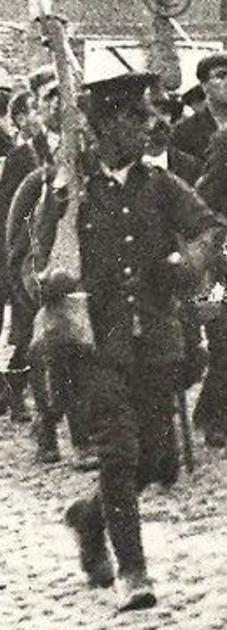
The main protagonists of World War One all had their colonies and many of the British servicemen of colour were from the Caribbean so it is probably that the soldier at the RDS especially with his happy outlook was most likely from the opposite side of the Atlantic. By the end of WW1, 15,000 West Indians had joined and served in the British Army. As rebels are marched along the quays of the River Liffey towards ship in Dublin port to take them to prison and internment camps a photograph taken as they crossed O'Connell Bridge may have snapped that very same British soldier acting most likely as an ADC to his commandant on horseback.


Sunday, May 28, 2017

1917 What was on Easter 1917


One year on from the momentous events of the Easter Rising and Dublin was still recovering, the centre of the city still a bomb site. April 9th was Easter Monday and Dublin was cold, windy with snow and sleet, a far cry from the sunny climate of Easter week. The British authorities had taken no chances and banned all outdoor gathering and processions to ward off trouble. The First World War continued and throughout 1917, Irishmen were still joining up. Many of those arrested after the Rising were still in prison in Britain and Ireland was suffering from rationing, job losses and steep increases in both food and alcohol prices.  Ireland though is changing as the radical nationalism of Sinn Fein begins to replace the moderate Nationalism of Redmond’s Home Rule party.

The main page of the Sunday Independent barely mentioned Ireland and its only reference was to possible nationalisation of the Liquor industry in Britain and Ireland due to wartime conditions. This was also leading to concern as many jobs were being lost at breweries and distilleries especially in Dublin as restrictions on production was imposed. Much of the news columns covered America’s declaration of war on the German Empire on April 6th. The Easter weekend had been a period of religious reflection with many businesses closed for the Holy Week.

The ban on meetings did not apply to indoor events and so the Dublin GAA annual convention went ahead as planned in the Mansion House. There was plenty of sport to occupy the mind but weather conditions reduced the attendance numbers at most events, which was a bonus on the Monday for theatres and cinemas.

The Grand National went ahead at Faiyhouse where Pay Only picked up the first prize of two hundred pounds. Second place despite all their efforts only won twenty pounds. There was whippet racing at Shelbourne Park, hockey in the Phoenix Park, soccer matches in the Leinster Senior League and club GAA matches at Croke Park and Ringsend Park.

The back page of the Freeman’s Journal on Monday along with actions photos of the Louth v Wexford GAA match was the news that the eldest son of British Prime Minister Lloyd George, Major Richard Lloyd George had got married. But as the year anniversary arrived on Easter Monday the theatre and cinemas were busy.

The D’Oyly Carte theatre company whose run at the Gaiety Theatre had been shut down as events unfolded on O’Connell Street and nearby St Stephen’s Green, were once again opening at the Gaiety with their production of The Gondoliers. The Theatre Royal’s acts on Monday night included Miss Marie Loftus, opera singer, George Forde, ventriloquist and Fred Curran, comedian who would become the opening act for Harry Houdini. The Abbey Theatre was performing G B Shaw’s ‘ John Bulls Other Island’ with Fred Donovan playing the role of Father Keegan. The Empire show was headlined by Miss Victoria Monks, while the Tivoli had Cooper and Lait topping the bill with comedian J B Strain. At the Queens the play ‘Under Two Flags’ was being performed.

Cinema was also growing rapidly although many of the cinemas in the centre of the city had been destroyed during the Rising bombardment. The Grafton Picture House
was showing ‘The Majesty of the Law’ accompanied by a performance by a visiting Russian violinist. The Pillar Picture House had Charlie Chaplin’s ‘The Pawnshop’. Across Ireland various Chaplin movies were on Easter Monday. At Mullingar you could have caught his film ‘in two parts’ The Fireman while Police was being shown at the Coliseum in Cork City.

On Easter Monday just before midday a crowd gathered outside the ruins of the GPO and a rebel flag was hoisted on a temporary flagpole at the corner of the building. It was lowered to half mast the stroke of one. As the police attempted to arrest those with flags, they were attacked and stones thrown gathered from the rubble of the street. There were a number of baton charges on O’Connell Street and Eden Quay with skirmishes continuing into the afternoon. The newspapers reported that a heaviy snowfall just after 10pm cleared the street of the ‘rowdies’. The only mention in Monday’s paper of any republican activities was a gathering of about a hundred ladies in Glasnevin where they laid wreaths on the graves of Volunteers killing during the Rising.


One strange quirk of the weekend in Dundalk related to the merging of Irish time and London time in October 1916 when Catholic churches in the town advertised Mass in Irish Time while the Protestant services were advertised in the new time leading to confusion in the town.     

Saturday, May 27, 2017

1917 The Banned Movie

British sensitivities were still on heightened alert as 1917 began. In January 1917 a film opened to packed houses in the Rotunda Picture House. ‘Ireland A Nation’ had been shown to and passed in December 1916 by the censor

The film itself had actually first been shown in 1914 and was made by the Gaelic Film Company. A silent movie it told the story of Ireland from the time of the 1798 rebellion, Robert Emmet in 1803 and up to the planned arrival of Home Rule, itself having been put on the back burner in 1914. It used dramatic scenes and screen titles to tell its story.  The film website IMDB described the film as,
‘The story of Ireland and her fight for Home Rule, as seen through the experiences of Father Tom Murphy, a patriot with a price on his head, and the famous Irish leader Robert Emmet.’

The film was produced by Lismore, Co Waterford born Walter McNamara. McNamara who according to the magazine ‘Moving Picture World’ was a vice president of the Gaelic League and one of the founders of the Irish Club in London. He had been educated in Wales before heading to the United States and became involved in the silent movie business.

The movie had its exterior shots filmed on location in Ireland including at Glendalough and the Vale of Avoca in Wicklow. The interior shots were filmed at  Ec-Ko Studios at Kewbridge in England which led to many continuity errors which was perhaps the least of its problems as it was often factually inaccurate as well. It starred Barry O’Brien as Emmet. O’Brien was an actor born in London in 1893, passing away in 1961.  Dominick O’Reilly played the role of Napoleon Bonaparte with supporting cast including Patrick Ennis and Barry Magee. Interviewed by George Blaisdell, McNamara spoke about his time in Ireland making the movie.
“Did I have any difficulties finding locations? Yes in one instance when I tried to find a mud hut and failed. Parnell wiped those out. I did though get some wonderful backgrounds.  We had a fort built by Oliver Cromwell and to this day no real son of the old sod passes it without spitting, that’s the only way they can adequately express his feelings for the builder. Were obstacles placed in my path in the making of Ireland a Nation? Yes indeed by the soldiers. Sometimes we would start a scene with not a soul in sight. It seemed sometimes that in two minutes soldiers would come from everywhere and demand to see a permit. The military tried in every way to handicap us. That’s why we were five months over there. The Nationalist Party gave us unofficial sanction.”

When he arrived in Ireland he was arrested by the British on suspicion of importing arms illegally but these weapons were discovered to be props for his film. McNamara was released but his props were not returned to him.

Even though the censor passed the film, he did so with some cuts to the original. Scenes including the interruption by British soldiers of a hillside Mass being celebrated by a Priest and the execution of Robert Emmet plus some of the intertitles were cut including one that told viewers that ‘a price of £100 dead or alive on the hed of every priest’.

On Wednesday September 23rd 1914 it had its premiere at the 44th Street Theatre in New York and played to big audiences in New York and Chicago despite being panned by most critics.
The tag line for the movie on its release was
‘Made in Ireland by Irish Actors, 116 years of Irish History in 5000ft of film’
Shown twice a day, tickets cost the movie goer either 25c or 50c.

A copy was being sent to Ireland for showing in May 1915 but it was on board the Lusitania when it was sunk by a German submarine. The intervention of the Easter Rising prevented another copy arriving and so it was January 8th 1917 before the Irish public got to see the film although with cuts to the original implemented by the censor. Newspaper advertisements called the film "The Greatest Patriotic Picture Ever Screened".  The Rotunda’s 1500 seats were sold out for two consecutive nights but when reports after the first couple of nights that audiences were cheering the death of British forces in the film’s depiction of the 1798 rebellion and roaring ‘up the Republic’ during some scenes, the military authorities banned the film.

The film would not be seen again in Irish cinemas until 1922 when extra scenes of the aftermath of the Rising, the War of Independence and DeValera’s visit to the United States were included.

Bibliography

 ‘A Special Relationship, Britain Comes to Hollywood’ by Anthony Slide
IMDB
Trinity College Archives
New York Tribune
Silentera.com


Thursday, May 25, 2017

1917 Another Potato Famine

A year after the Easter Rising the preoccupation of British newspapers with the Irish question wasn’t the reaction to the rebel executions, the rise of Sinn Fein or the massive amount of arms still in circulation on the island but headlines blazed about the humble potato.

The British were relying on food crops grown within the British Isles as German submarines were having an affect on imported goods and ships were being used for military purposes rather than food transport. The potato harvest in both Ireland and Scotland had been particularly poor in 1916 and the word ‘famine’ was again circulating. The yield in Ireland in 1916 was a quarter of a millions tons less than a year earlier and exporting from Ireland had been interrupted by the events of Easter week. Towards the end of 1916 the British Government prohibited the export of potatoes from Ireland to Britain leading to major shortages in Britain.
The Belfast News wrote,
“From Clare to Donegal and Dublin to Sligo thoughtful men are asking ‘what will happen if the people’s food is sold for export?’ there is only one answer –famine”

The Donegal Vindicator added
“The crisis has found Ireland as unprepared as the war found Great Britain. The potato famine is upon us and so are the exporters. The farmer who sells his potatoes for export today must be restrained by his more sensible neighbours. There is a food crisis.”

By early 1917, the wholesale cost of the spud had mushroomed. A ‘CWT’ (8 stone bag) of potatoes that cost between four and eight schillings in 1916, a year later was costing between eleven and fourteen schillings. Some Irish exporters had been accused of withholding supplies for export to take advantage of the ever increasing wholesale prices. The embargo was lifted on the Irish potato in July 1917 but not before the British Government ordered the Irish farmer to sell his crop for a maximum of £6 10s per ton or 1s per stone down from the reported £14 some farmer had been receiving.    

By March there were prosecutions in Ireland of those appearing to profiteer. Potato sellers Thomas Sheridan and Sons were fined £5 and £2 costs for selling potatoes wholesale to Mary Keating of Arklow for 11s 6d a CWT on March 9th when the maximum at the time was 10s 10d per CWT. There were many such prosecutions during the following six months across the country.

One newspaper editorial in Wales, an area that had been severely affected by the potato shortages wrote,

“Potatoes are not worth buying if they cost more than 4s a cwt. They have been as high as 8s this spring. The potato is of very little value as food. There is not more than   two per cent of nutriment in the potato. Potatoes at 8s a cwt are equivalent in price to oatmeal as 1s per lb which is absurd. We have largely become the victims of the potato habit. In the early part of the nineteenth century potatoes could be had for two or three shillings a cwt. In those times anybody could live for about a shilling a week on potatoes. The root had very little dietetic value; but it was "filling" and cheap at the price. When however the potato begins to cost the price of a genuine food, it is time- its character was exposed. If you have a. good dinner it is all very well to have a few potatoes as "extras" just as you would have a few tomatoes or Brussels sprouts but to regard the potato as an article of diet in itself is rank folly. If the potato were relegated to its proper place the consumption of that fraudulent tuber would decrease and its price would fall accordingly. People acquired the taste for the potato in an age of poverty and they go eating it quite regardless of the fact that its food value is almost nil. The extraordinary prices which potatoes reached in the spring were due to the rebellion in Ireland. They grow huge quantities of potatoes in Ireland but they are not so foolish as to eat them. The Irish labourer has long ago got over his partiality for potatoes. He lives on tea "soda-bread" and American bacon. Liverpool, Fleetwood, .Glasgow and Bristol all receive daily shiploads of potatoes from Ireland. There is never usually more than a week's supply of potatoes in hand in the big towns of England and Scotland. When the Sinn Fein flare-up took place all shipping between this country and Ireland was held up for a couple of weeks, and it was a month before things became normal. In the meantime the grocers in this country were getting desperate for potatoes. Travellers from Manchester and Edinburgh were scouring the wilds of Wales offering any prices for a few sacks of potatoes. The only cure for the high price of potatoes is for people to use less of them. Those who eat meat can do with less potatoes. Puddings are cheaper than potatoes just now. Those who don't use meat should not use potatoes at all. As a food they are useless; their proper function is to serve as an adjunct to meat. Our fathers formed dietetic habits when certain articles of food were cheap. When circumstances alter the habits should alter. The only point in favour of the potato is its cheapness. Once it ceased to be cheap, it ought to be discarded.”

In parts of England especially Lincolnshire,a good potato growing county, there was a different kind of Irish problem when it came to harvesting the potato crop. In 1917 the ‘Irish Need Not Apply’ signs went up at farms, pubs and shops. The local community turned on Irish labourers who would travel across the Irish Sea for seasonal work as local Englishmen serving in the British Army who were conscripted and had been sent to Ireland during and after the Easter Rising were paid one schilling per week but the Irish who had replaced them in the fields and were exempt from conscription in what locals saw as appeasement were being paid between five and seven schillings a week to replace them.


By the end of 1917, the price had stabilised and the threat of famine in both Ireland and Britain had receded but by the end of that year consumers had discovered alternatives to the potato like swede, turnip and parsnip and as the First World War came to a conclusion the potato crisis had abated.  

Monday, May 22, 2017

1917 Ireland's Top Sportsman


In 1917, Wexford won the All Ireland Football Final which Dublin secured the title in Hurling. In soccer Glentoran won the double taking both the League and the Cup, while for a number of months Ireland was the only place in the British Isles to the support the sport of Kings, horse racing but the most famous Irish sportsman in the United States at the time played none of these sports.

Bernard Michael Riley was born in 1891 in Ballinamore, County Leitrim before his family immigrated to the United States. By eighteen years old he was known as ‘Irish Mick’ or ‘The Wild Irish Rose of Skidom’ as Barney as he was now known became the US National Amateur Champion Ski jumper.

The Riley family had settled in Coleraine, Michigan an area of the US where many Scandinavians settled and they brought their tradition of snow sports to the North East of the continent.  And while names like Solberg, Bergensen, Olsen and Jensen dominated the ski slopes in the US, an Irishman would break their stranglehold.

In February 1910 Riley was crowned US National Champion in front of 6,000 spectators setting a world record jump on his way to the title. He defended it successful y the following year and I 1911 even won the prestigious Nor Trophy, a competition set up by and dominated by Norwegians who had like Riley found a new home in the United States. He also picked up the $300 defeating a future Olympic bronze medallist Anders Haugen who competed for the USA despite being born in Telemark, Norway.
The newspapers of the day reported
‘At the Norwegian games he (Riley) was the possessor of enough medals to decorate a German prince, all won by his skills on the skis’

In 1913 Riley turned professional and toured the growing and successful skiing circuit. The First World War would intervene and Riley joined the US Army in 1917 being posted to France when that nation entered the war, serving as a railway engineer in France. Riley entry into the US Army made headlines on the sports pages of late 1917 as his fame as a ski jumper had continued to expand.

After the war he returned to ski jumping and his Irishness was trumpeted in advertising for various metes including the 1924 inaugural event at the Chester Bowl in Duluth, Minnesota, the state that Riley now called home. He won the inaugural event with a jump of 137 feet. He would later exchange holder of the ski jump world record with Anders Haugen at one tournament out jumping the Olympic medallist with a jump of 154 feet only to fall on landing. He would never again hold the record.


Barney Riley died in February 1939 when he suffered a heart attack and died as he was moving his car from his garage at home. In 2011, the ‘Wild Irish Rose of Skidom’ was inducted into the American Ski Jumping Hall of Fame.